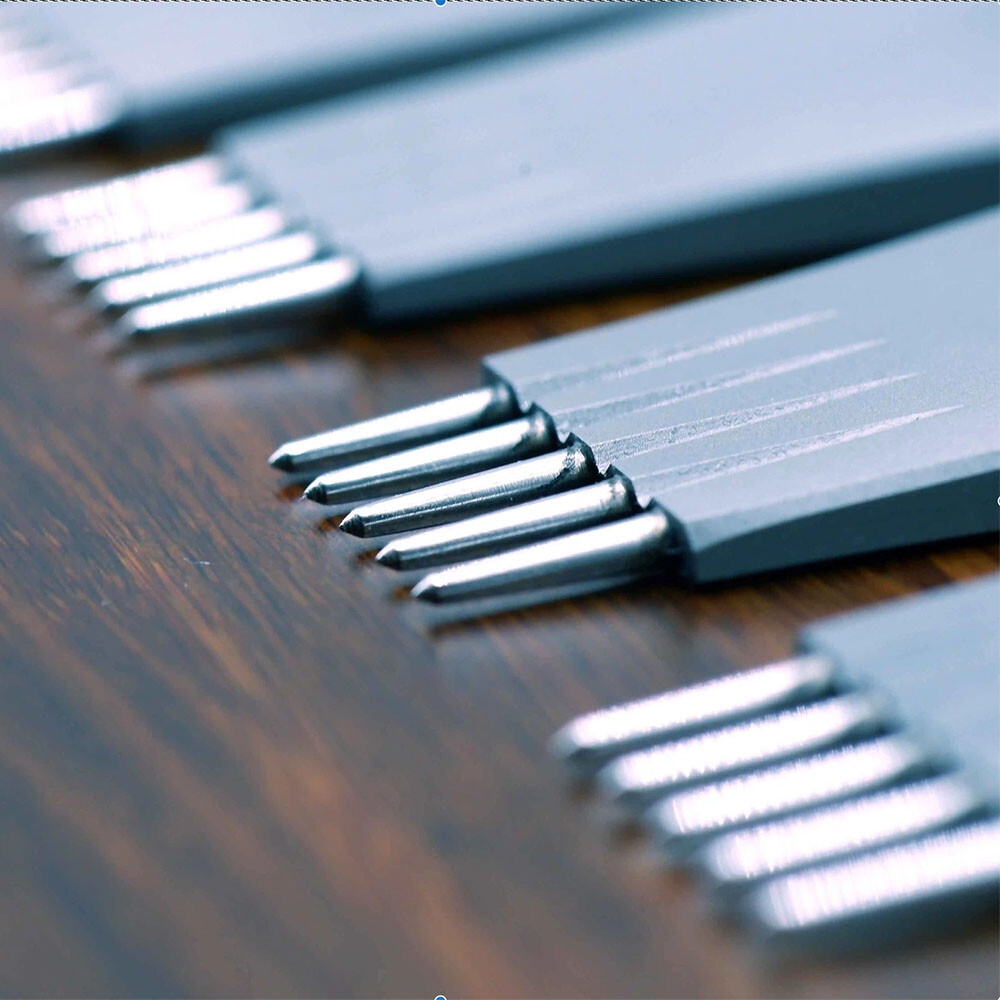

Photos from current listings. Actual item, color, and included accessories may vary.
Heavy Duty Leather Punch Buying Guide
Heavy-duty leather punches are the leverage-driven tools that cut clean holes through thick veg-tan, bridle, and harness leather where handheld rotary punches fail. The core trade-off is between jaw-style plier punches (fast but limited by throat depth and hand force) and arbor-press or hammer-driven hollow punches (unlimited thickness, but needing a press or mallet and a cutting pad). Buy a plier punch for straps and belts up to roughly 4 mm; step up to a press or hollow punch set for anything thicker or for repeated production work.
Median $175.00
Key takeaways
- Plier punches multiply hand force through compound linkage; throat depth (typically 25–50 mm) sets the maximum distance from the edge you can reach.
- Hollow punch sets cut by shearing against a polymer or end-grain wood pad; punch diameter tolerance and steel hardness (58–62 HRC) decide edge life.
- Arbor-press punches need a drill-press or dedicated arbor frame; hammer-driven punches need only a mallet and pad but deform faster on hard tempers.
At a glance
- Category
- Leather Cutting & Punching Tools
- Last updated
- Nov 27, 2026
Current offers
Highlights
- Plier punches multiply hand force through compound linkage; throat depth (typically 25–50 mm) sets the maximum distance from the edge you can reach.
- Hollow punch sets cut by shearing against a polymer or end-grain wood pad; punch diameter tolerance and steel hardness (58–62 HRC) decide edge life.
- Arbor-press punches need a drill-press or dedicated arbor frame; hammer-driven punches need only a mallet and pad but deform faster on hard tempers.
- Rotary and plier punches are sized in millimetres or inches with interchangeable tips; standard sizes run 2–6 mm for hardware and 1–4 mm for stitching.
Best use cases
- Best fit: belt and strap makers punching 3–4 mm veg-tan — choose a plier punch with a 38 mm+ throat and interchangeable 3–5 mm tips; skip hollow sets that need a press.
- Best fit: harness, saddle, and armour work above 5 mm — use an arbor-press hollow punch with a hardened steel tube and a sacrificial pad; skip plier punches, which stall or deform.
- Wrong fit: high-volume workshop punching hundreds of holes daily — a manual plier or mallet punch wears out; choose a press-mounted or lever-driven punch with replaceable cutting tubes.
- Wrong fit: thin garment or chrome-tan leather under 1.5 mm — heavy-duty punches tear or stretch the fibre; use a rotary punch or drive punch with a fine tip instead.
Buying tips
- Match punch diameter to hardware: 3 mm for 2–3 mm rivets, 4 mm for 4 mm snaps and Chicago screws, 5 mm for 5 mm eyelets and buckles; oversized holes weaken the strap.
- Check jaw throat depth against your widest strap: a 38 mm throat reaches the centre of a 75 mm belt; anything wider needs a hollow punch or press.
- Prioritise hardened tool steel (58–62 HRC) or coated High-Speed Steel tubes; soft carbon steel deforms after a few hundred holes in thick veg-tan.
- For press use, confirm the punch shank diameter matches your arbor press ram (commonly 6–10 mm) and that the tube is hollow-ground for clean shear.
Specs
| Punch Type | Plier / Hollow / Arbor-press |
|---|---|
| Max Leather Thickness | Plier ~4 mm; Press 6 mm+ |
| Throat Depth | 25–50 mm (plier reach) |
| Punch Steel Hardness | 58–62 HRC tool steel |
Related searches
What to check before buying
- Measure your thickest leather in millimetres; plier punches top out around 4 mm, so anything above that needs a press or mallet-driven hollow punch.
- Measure the distance from the strap edge to the hole centre; this must be less than the punch throat depth or the tool will not reach.
- Confirm you have a stable work surface and a polymer or end-grain wood cutting pad; hollow punches dull instantly on metal or glass.
- Check that replacement tips or tubes are available in the diameters you need before committing to a proprietary punch system.
FAQ
Data sources: eBay / Amazon listings and product attribute feeds. Updated Nov 27, 2026.
Some links on this page are affiliate links. If you buy after clicking one, we may earn a commission at no extra cost to you. This does not change which products appear here or their order. Affiliate disclosure.