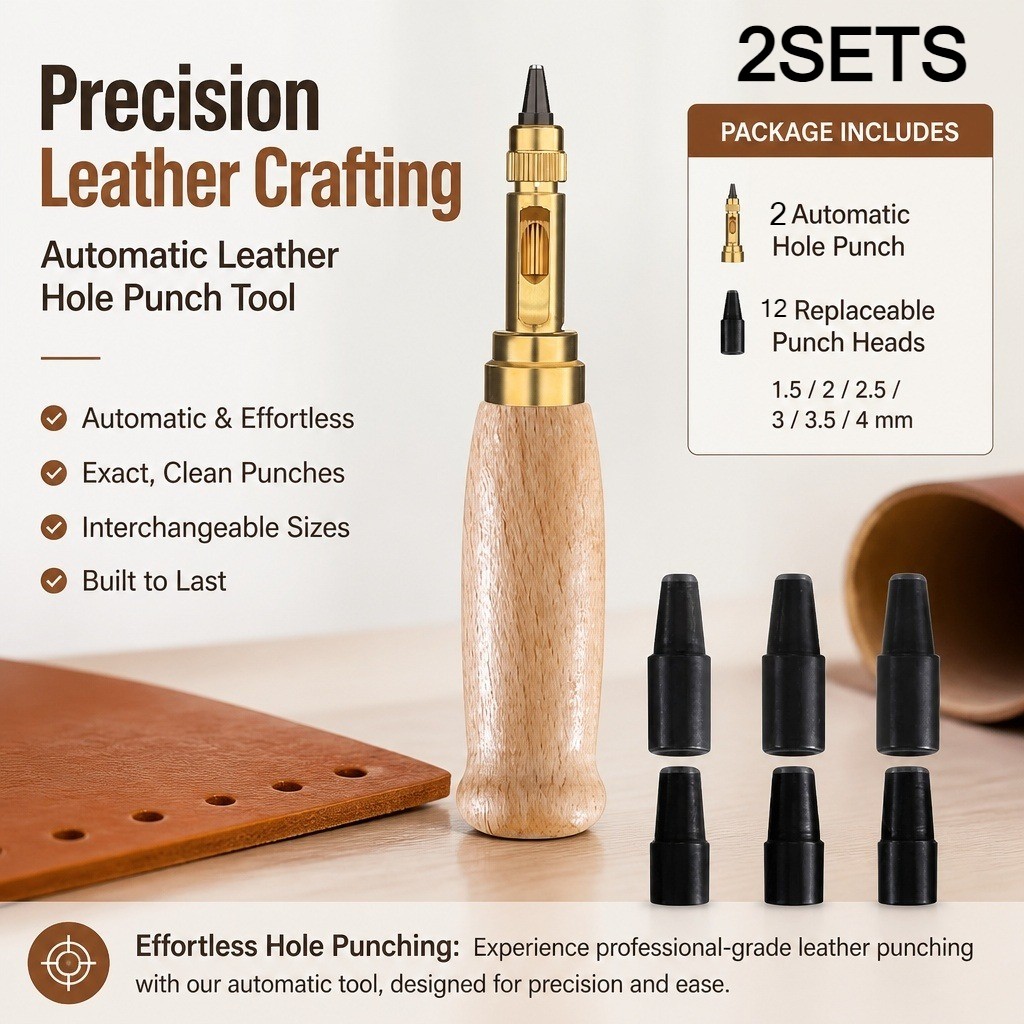

Photos from current listings. Actual item, color, and included accessories may vary.
Hole Punch Buying Guide
A leather hole punch is a dedicated tool for creating clean, round holes in leather, synthetics, and heavy fabrics—critical for belts, straps, watch bands, and lacing. The core trade-off is between rotary plier-style punches (fast, size-selectable, but limited by jaw depth and leverage) and drive-punch or chisel sets (hammered or pressed, superior on thick stock and tight spacing, but requiring a mallet or press). The decision rule: for belts and straps up to 4mm thick with edge-access holes, a rotary punch with hardened steel tips is sufficient; for thick veg-tan, tight stitch-line holes, or production repeatability, step up to a forged drive-punch set or a rack-and-pinion press.
Median $61.60
Key takeaways
- Rotary punches use a revolving head with 5–6 tapered tips (typically 2–4.5mm); the jaw throat depth (usually 25–40mm) directly limits how far from the edge you can punch.
- Drive punches and chisels are struck with a mallet; forged, hardened steel (HRC 50–58) resists mushrooming, while hollow-ground tubes eject slugs cleanly on thick leather.
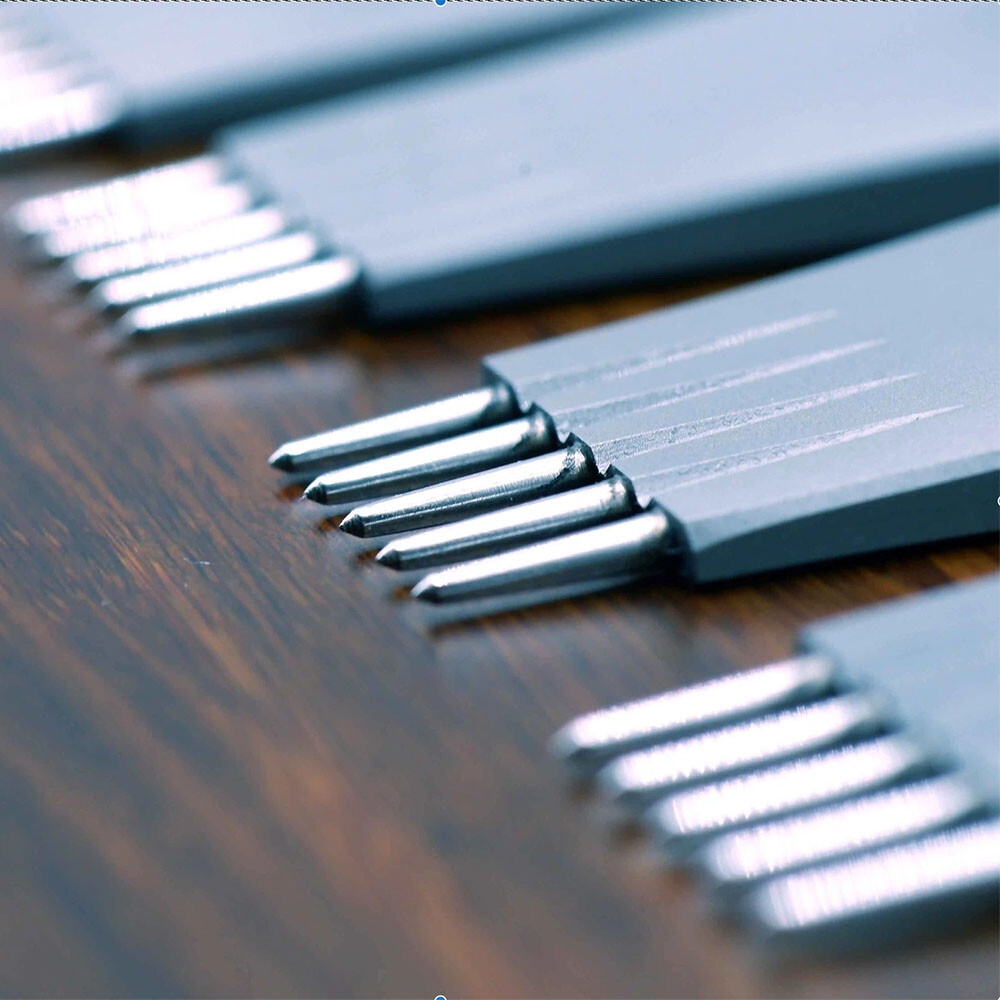
- Pricking irons (stitching chisels) are measured in stitch pitch (e.g., 4mm, 5mm, 6mm) and tooth count (2, 4, 6); they mark and pierce for saddle stitching, not for hardware holes.
At a glance
- Category
- Leather Cutting & Punching Tools
- Last updated
- Nov 27, 2026
Current offers
Highlights
- Rotary punches use a revolving head with 5–6 tapered tips (typically 2–4.5mm); the jaw throat depth (usually 25–40mm) directly limits how far from the edge you can punch.
- Drive punches and chisels are struck with a mallet; forged, hardened steel (HRC 50–58) resists mushrooming, while hollow-ground tubes eject slugs cleanly on thick leather.
- Pricking irons (stitching chisels) are measured in stitch pitch (e.g., 4mm, 5mm, 6mm) and tooth count (2, 4, 6); they mark and pierce for saddle stitching, not for hardware holes.
- Rack-and-pinion or arbor presses convert lever force into vertical pressure, enabling clean holes through 6mm+ leather with minimal edge distortion.
Best use cases
- Best fit: DIY belt sizing and watch-band adjustments—choose a rotary punch with 2–4.5mm tips and at least 30mm jaw depth; skip pricking irons, which are for stitching, not hardware holes.
- Best fit: Saddlery and thick veg-tan (4mm+)—use a forged drive-punch set (2–5mm) with a poly mallet on a polymer cutting board; skip plier-style rotary punches, which deflect and distort on thick stock.
- Best fit: Repeatable production or tight stitch-line holes—choose a rack-and-pinion press with interchangeable tubes; skip hand chisels if you need identical hole spacing across dozens of pieces.
- Wrong fit: Fabric-only or paper craft—a rotary punch or drive punch will crush and tear thin materials; use a hollow fabric punch or awl instead.
Buying tips
- Match tip diameter to hardware: 2mm for rivets and small snaps, 3mm for lacing and belt buckles, 4–4.5mm for heavy buckles and eyelets; buy a set covering at least 2–4.5mm.
- Check jaw throat depth on rotary punches: 25mm reaches most belt edges, but 35–40mm is needed for holes centered on wide straps or bag gussets.
- For drive punches, confirm the shank is hardened tool steel (not mild steel) and the cutting edge is hollow-ground; mild-steel punches dull in a few dozen holes on veg-tan.
- Pricking iron pitch must match your stitch length: 4mm pitch suits fine goods and small pouches, 5mm is general leathercraft, 6mm suits heavy belts and holsters.
Specs
| Punch Type | Rotary plier / Drive punch / Press |
|---|---|
| Hole Size Range | 2–4.5mm (rotary) / 1–6mm (drive set) |
| Jaw Throat Depth | 25–40mm (rotary models) |
| Steel Hardness | HRC 50–58 (hardened tool steel) |
Related searches
What to check before buying
- Measure your thickest leather: rotary punches handle up to ~4mm comfortably; anything thicker needs a drive punch or press.
- Confirm edge access: measure the distance from the leather edge to the hole center; it must be less than the rotary punch's jaw throat depth.
- Have a striking surface: drive punches and chisels require a polymer or HDPE cutting board and a non-metal mallet (rawhide or poly).
- Check tip replaceability: rotary punch heads with screw-in or press-fit tips can be renewed; fixed-head models must be replaced entirely when dull.
FAQ
Data sources: eBay / Amazon listings and product attribute feeds. Updated Nov 27, 2026.
Some links on this page are affiliate links. If you buy after clicking one, we may earn a commission at no extra cost to you. This does not change which products appear here or their order. Affiliate disclosure.