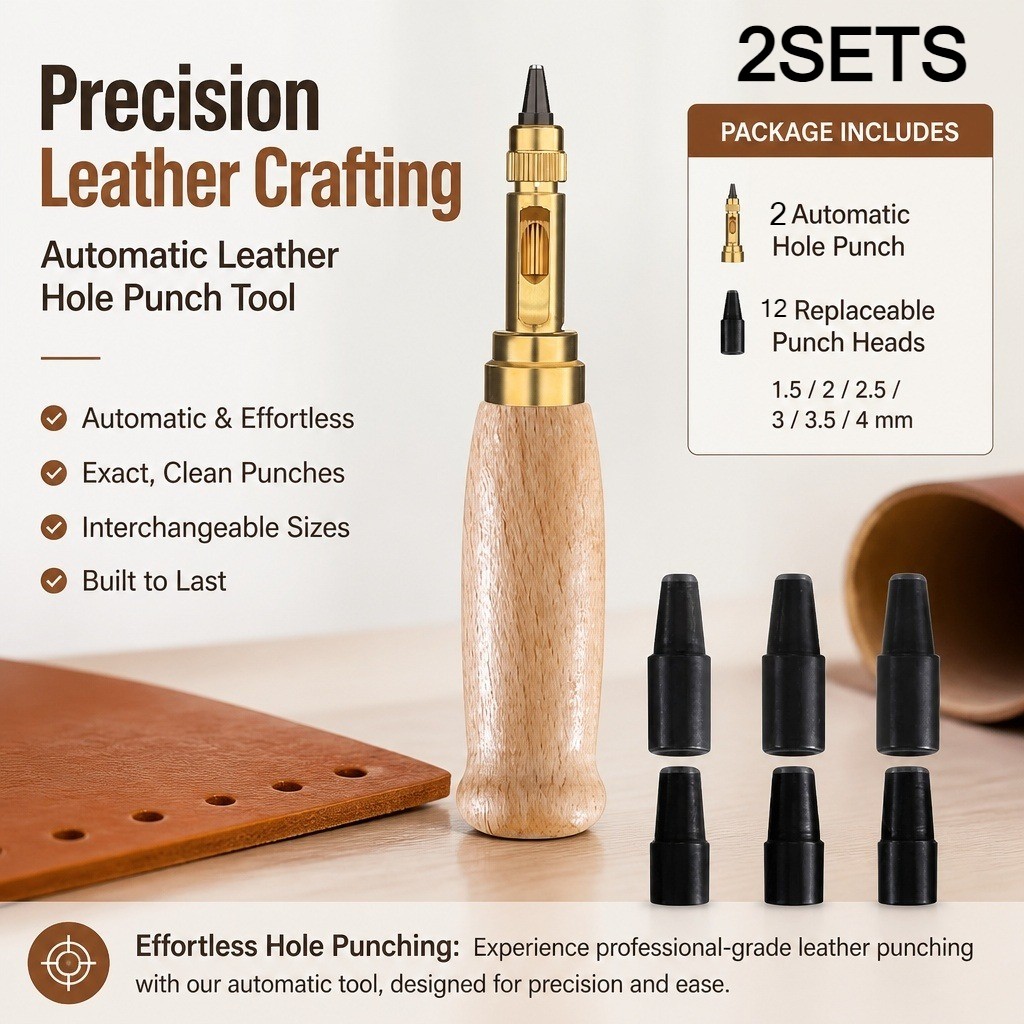

Photos from current listings. Actual item, color, and included accessories may vary.
Leather Hole Punch Buying Guide
A leather hole punch is a dedicated edge-cutting tool for creating clean round holes in leather, belts, straps, and craft projects — distinct from awls (which pierce) and rotary punches (which shear). The core trade-off is between a single rotating plier-style punch (fast, adjustable, but limited to thin leathers) and a hardened steel drive punch or pricking iron (precise, durable, but needs a mallet and cutting mat). Buy the rotating plier if you punch soft leather under 3 mm; buy a solid steel drive punch or chisel set if you need repeatable holes in thick veg-tan or production work.
Median $61.60
Key takeaways
- Rotary plier punches use a hardened steel tube on a rotating disc; the tube shears a clean circle only if the leather is under roughly 3 mm thick.
- Drive punches and pricking irons are single-piece hardened tool steel (typically 45# or Cr12MoV) meant to be struck with a mallet — they punch through 4–6 mm veg-tan without deforming.
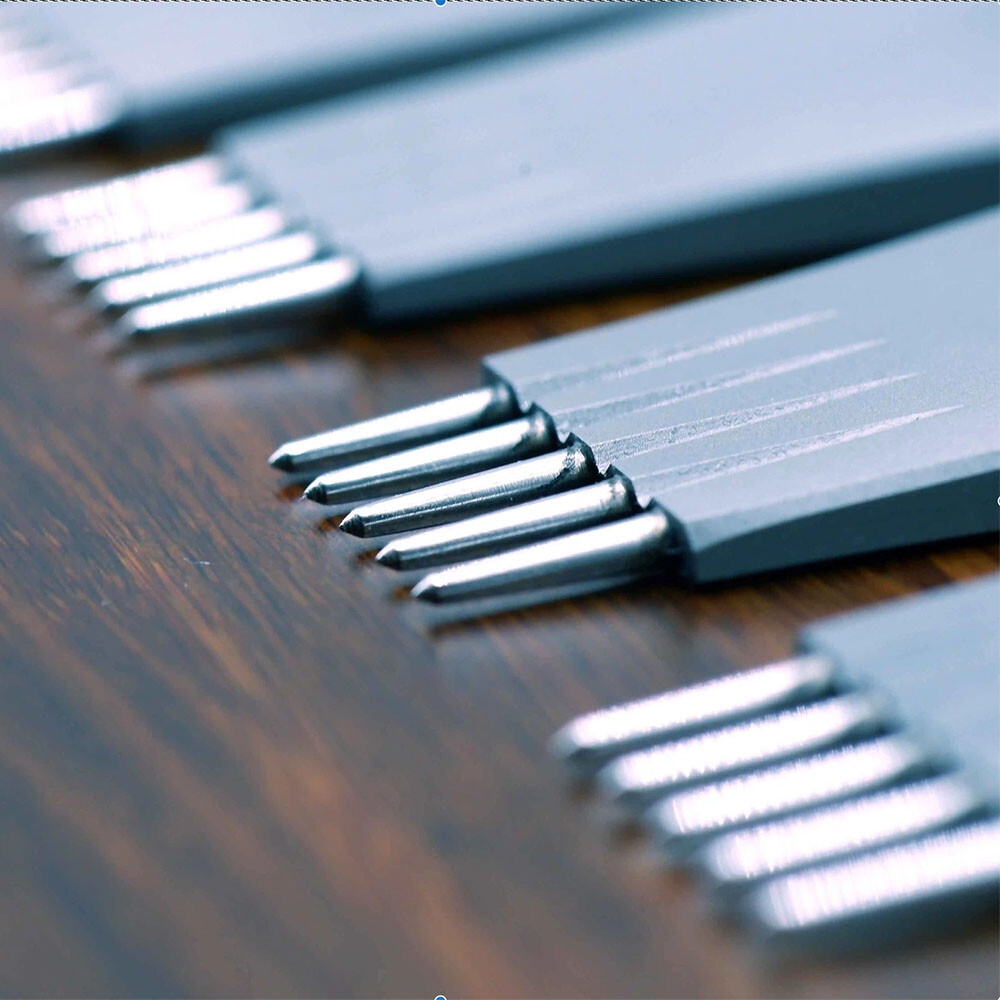
- Pricking irons / stitching chisels are not round-hole punches: they cut diamond or French-style slots for saddle stitching, with 2, 4, or 6 prongs at 3–5 mm spacing.
At a glance
- Category
- Leather Cutting & Punching Tools
- Last updated
- Nov 27, 2026
Current offers
Highlights
- Rotary plier punches use a hardened steel tube on a rotating disc; the tube shears a clean circle only if the leather is under roughly 3 mm thick.
- Drive punches and pricking irons are single-piece hardened tool steel (typically 45# or Cr12MoV) meant to be struck with a mallet — they punch through 4–6 mm veg-tan without deforming.
- Pricking irons / stitching chisels are not round-hole punches: they cut diamond or French-style slots for saddle stitching, with 2, 4, or 6 prongs at 3–5 mm spacing.
- Hole size is specified in millimetres (common: 2.0, 2.5, 3.0, 3.5, 4.0 mm); belt holes typically need 3.5–4.0 mm, while hardware rivets and snaps need the exact shaft diameter.
Best use cases
- Best fit: home crafters punching belts, bag straps, and watch bands up to 3 mm — pick a rotating plier punch with 6 sizes; skip heavy drive punches unless you also own a mallet and cutting mat.
- Best fit: leatherworkers stitching holsters, sheaths, or bags — pick a 4-prong pricking iron at 4 mm spacing; skip rotary punches, which cannot cut stitching slots cleanly.
- Best fit: saddlers or production shops punching 4–6 mm veg-tan — pick a hollow drive punch in the exact diameter plus a poly cutting board; skip plier punches, which bend on thick leather.
- Wrong fit: punching fabric, paper, or soft plastics — use dedicated fabric hole punches; leather punches dull quickly on abrasive synthetics.
Buying tips
- Match punch diameter to hardware: measure the rivet or snap shaft with calipers; a 3.5 mm punch suits most 3 mm belt holes, while 4.0 mm suits 4 mm rivets — undersized holes tear, oversized holes loosen.
- Check steel hardness and construction: rotary punches should have hardened steel tubes and a brass or steel disc; drive punches should be one-piece forged steel, not stamped sheet metal.
- For stitching, pick pricking iron spacing to match thread: 3 mm spacing for fine 0.6 mm thread, 4 mm for 0.8 mm thread, 5 mm for heavy 1.0 mm thread — wrong spacing ruins stitch rhythm.
- Verify the punch reaches your work: plier jaws open to roughly 25–30 mm; drive punches need a clear strike path and a dense polyethylene or rubber cutting mat, not a wooden block.
Specs
| Punch Type | Rotary plier / drive punch / pricking iron |
|---|---|
| Hole Diameter | 2.0–4.0 mm round (belt: 3.5–4.0 mm) |
| Max Leather Thickness | Plier: ~3 mm; drive punch: 4–6 mm |
| Pricking Iron Spacing | 3 / 4 / 5 mm (2, 4, 6 prongs) |
Related searches
What to check before buying
- Measure leather thickness at the hole location: under 3 mm suits rotary plier punches; 3–6 mm needs a struck drive punch or pricking iron.
- Confirm the punch diameter matches your rivet, snap, or buckle tongue — measure the hardware shaft, not the outer cap.
- For pricking irons, confirm prong count and spacing match your stitch length and thread weight before buying.
- Check you have a mallet (for drive punches) and a self-healing cutting mat; rotary punches need only a flat work surface.
FAQ
Data sources: eBay / Amazon listings and product attribute feeds. Updated Nov 27, 2026.
Some links on this page are affiliate links. If you buy after clicking one, we may earn a commission at no extra cost to you. This does not change which products appear here or their order. Affiliate disclosure.