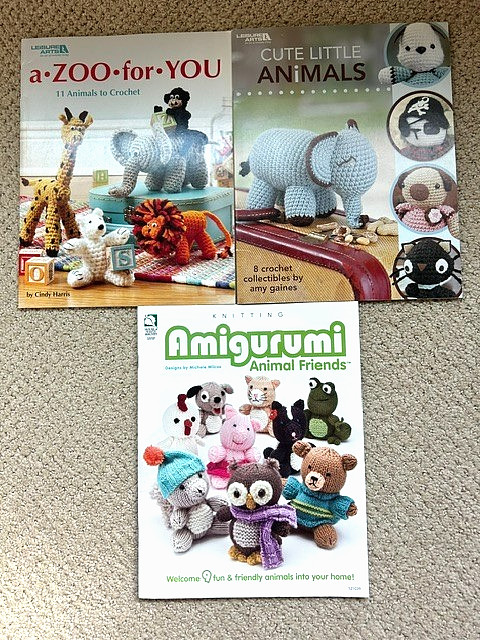

Photos from current listings. Actual item, color, and included accessories may vary.
Crochet Animal Pattern Buying Guide
Crochet animal patterns are written instructions—often amigurumi-style—for making stuffed animals, and the core trade-off is between simple continuous-spiral shaping (fewer pieces, faster finish) and multi-part construction with embroidered or jointed details (more realism, more assembly). Choose spiral-in-the-round patterns for durable, child-safe toys; choose flat-panel or seamed patterns only when you want larger display pieces and accept visible seams.
Key takeaways
- Amigurumi shaping runs on single crochet worked in a continuous spiral; a tight 5.0–6.0 mm hook with worsted yarn yields dense fabric that holds stuffing without showing gaps.
- Safety eyes create a choking hazard on toys for children under 3; embroidered or crocheted eyes are the durable choice for baby-safe animals.
- Jointed limbs use plastic safety joints or button-and-thread attachment; sewn-on limbs are simpler but can loosen with heavy play.
At a glance
- Category
- Knitting & Crochet Patterns
- Last updated
- Nov 28, 2026
Current offers
Highlights
- Amigurumi shaping runs on single crochet worked in a continuous spiral; a tight 5.0–6.0 mm hook with worsted yarn yields dense fabric that holds stuffing without showing gaps.
- Safety eyes create a choking hazard on toys for children under 3; embroidered or crocheted eyes are the durable choice for baby-safe animals.
- Jointed limbs use plastic safety joints or button-and-thread attachment; sewn-on limbs are simpler but can loosen with heavy play.
- Cotton or acrylic worsted-weight yarn at 4–5 stitches per inch is the standard gauge; bulky chenille yarn needs a 6.0–8.0 mm hook and produces larger, softer animals with looser stitches.
Best use cases
- Best fit: choose a continuous-spiral amigurumi pattern with embroidered eyes for baby gifts and toys for children under 3—skip patterns listing plastic safety eyes for that age group.
- Best fit: pick a multi-piece pattern with jointed limbs for adult collectors or display shelves where poseability matters; skip jointed patterns if the animal will be machine-washed or heavily handled by kids.
- Best fit: select flat-panel or seamed patterns when you want a larger animal (over 12 inches) or a beginner-friendly first project; skip them for small palm-sized toys where seams overwhelm the shape.
- Best fit: use bulky chenille yarn patterns for quick, soft oversized animals; skip them for detailed small animals because the yarn obscures stitch definition and face embroidery.
Buying tips
- Match hook size to yarn weight: worsted (4) uses a 5.0–6.0 mm hook; DK (3) uses 4.0–4.5 mm; bulky (5–6) uses 6.5–8.0 mm—patterns state the gauge, and a tighter gauge than specified makes a stiffer, smaller animal.
- Count the pattern's piece count: patterns with 8+ separate pieces require more seaming time; patterns with 3–5 pieces are faster to finish and less prone to seam gaps.
- Check the finished-size math: a pattern using worsted yarn and a 5.0 mm hook typically produces a 4–8 inch animal; doubling yarn weight roughly doubles the finished height.
- Verify the pattern format: written line-by-line instructions suit beginners; chart-only or symbol-diagram patterns demand prior amigurumi experience and are slower to read.
Specs
| Construction Style | Continuous spiral vs flat-panel seamed |
|---|---|
| Recommended Hook | 5.0–6.0 mm (worsted) / 6.5–8.0 mm (bulky) |
| Eye Type | Embroidered (baby-safe) vs plastic safety eyes |
| Finished Size Range | 4–12 in (worsted) / 12–20 in (bulky) |
Related searches
What to check before buying
- Measure your intended finished size against the pattern's stated gauge and yarn weight—most amigurumi patterns list finished height in the materials section.
- Confirm your yarn fiber suits the use: cotton and acrylic are machine-washable for children's toys; wool felts and pills with washing.
- Check safety-eye size and attachment type if the animal is for a child under 3—switch to embroidered eyes or skip the pattern.
- Verify you have the required hook size, stitch markers, and stuffing (polyester fiberfill) before starting; patterns assume these are on hand.
FAQ
Data sources: eBay / Amazon listings and product attribute feeds. Updated Nov 28, 2026.
Some links on this page are affiliate links. If you buy after clicking one, we may earn a commission at no extra cost to you. This does not change which products appear here or their order. Affiliate disclosure.