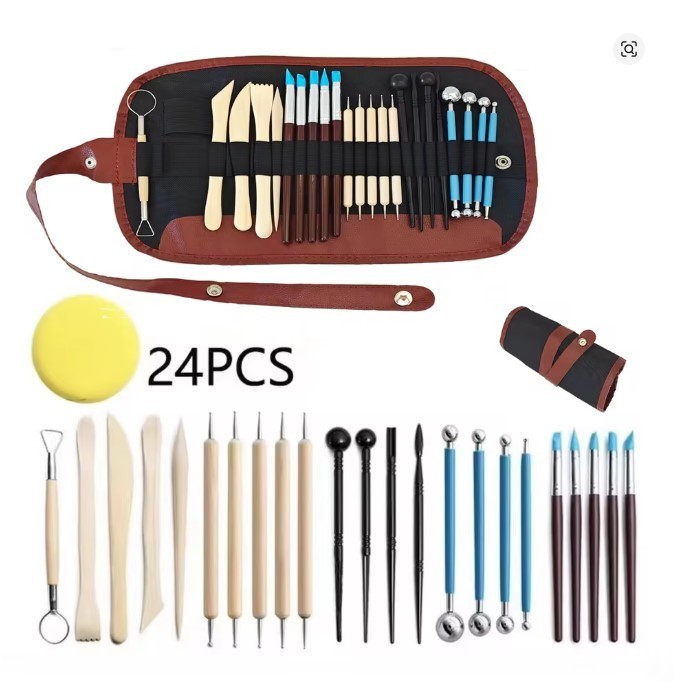

Photos from current listings. Actual item, color, and included accessories may vary.
Polymer Clay Tool Buying Guide
Polymer clay tools are the shaping, cutting, texturing, and finishing implements used to form oven-bake and air-dry polymer clay without marring the surface or leaving residue. The primary trade-off is between flexible stainless-steel or silicone-tipped tools that resist clay adhesion and cheap carbon-steel or porous plastic tools that rust, stain, or drag. The clear rule: buy tools with smooth, non-porous working ends (stainless steel, silicone, or hardened nylon) and avoid untreated carbon steel or fuzzy wooden tips that trap clay and leave marks.
Key takeaways
- Stainless-steel and silicone-tipped tools resist clay adhesion and rust; carbon-steel and wooden tools absorb oils and can stain light-colored clay.
- Clay hardness determines tool choice: firm clays need rigid stainless steel, while soft or detail clays need flexible silicone or nylon to avoid smearing.
- Ball-end and needle-point tools have specific diameters (1–6 mm balls, 0.5–1 mm points) that control detail scale; a set with graduated sizes covers more techniques.
At a glance
- Category
- Pottery Tools & Molds
- Last updated
- Nov 28, 2026
Current offers
Highlights
- Stainless-steel and silicone-tipped tools resist clay adhesion and rust; carbon-steel and wooden tools absorb oils and can stain light-colored clay.
- Clay hardness determines tool choice: firm clays need rigid stainless steel, while soft or detail clays need flexible silicone or nylon to avoid smearing.
- Ball-end and needle-point tools have specific diameters (1–6 mm balls, 0.5–1 mm points) that control detail scale; a set with graduated sizes covers more techniques.
- Blade thickness and bevel angle determine cut cleanliness: thin, sharp, straight bevels slice cleanly, while thick or serrated blades drag and distort clay edges.
Best use cases
- Best fit: graduated stainless-steel ball and needle tools for miniature sculpting and fine facial details; skip oversized wooden modeling tools that are too blunt for small scale.
- Best fit: silicone-tipped shapers and color shapers for blending seams and smoothing soft clay without fingerprints; skip metal tools on very soft clay where they gouge.
- Best fit: thin flexible stainless-steel blades and tissue blades for cane slicing and clean cuts; skip thick kitchen knives or serrated blades that compress the cane.
- Best fit: texture sheets, stamps, and needle tools for surface patterning and jewelry-scale work; skip heavy pottery ribs and loop tools intended for wet stoneware, which are oversized for polymer clay.
Buying tips
- Match tool material to clay firmness: firm oven-bake clay takes stainless steel; soft or extra-soft clay takes silicone or nylon to prevent drag marks.
- Choose a set with graduated ball diameters from about 1 mm to 6 mm and at least one 0.5–1 mm needle point for detail work; single-size tools limit versatility.
- For cane work, pick blades under 0.3 mm thick with a straight bevel; thicker blades compress the cane and blur the pattern.
- Verify handles are seamless and non-porous (stainless, anodized aluminum, or hard plastic); wooden handles with gaps trap clay and are hard to clean.
Specs
| Tool Material | Stainless steel / silicone / nylon |
|---|---|
| Ball End Sizes | 1–6 mm graduated |
| Blade Thickness | Under 0.3 mm straight bevel |
| Handle Type | Seamless non-porous |
Related searches
What to check before buying
- Confirm your clay type and firmness (oven-bake vs air-dry, soft vs firm) before choosing metal versus silicone working ends.
- Measure your working scale: miniature and jewelry work needs 1–6 mm ball ends and 0.5–1 mm points; larger sculpts can use 8–10 mm ends.
- Check that tool handles fit your hand comfortably for long sessions and that tips are securely fixed, not loose or interchangeable with play.
- Plan for storage and cleaning: non-porous tools wipe clean with alcohol; wooden or porous tools need dedicated storage and may transfer color between clay batches.
FAQ
Data sources: eBay / Amazon listings and product attribute feeds. Updated Nov 28, 2026.
Some links on this page are affiliate links. If you buy after clicking one, we may earn a commission at no extra cost to you. This does not change which products appear here or their order. Affiliate disclosure.