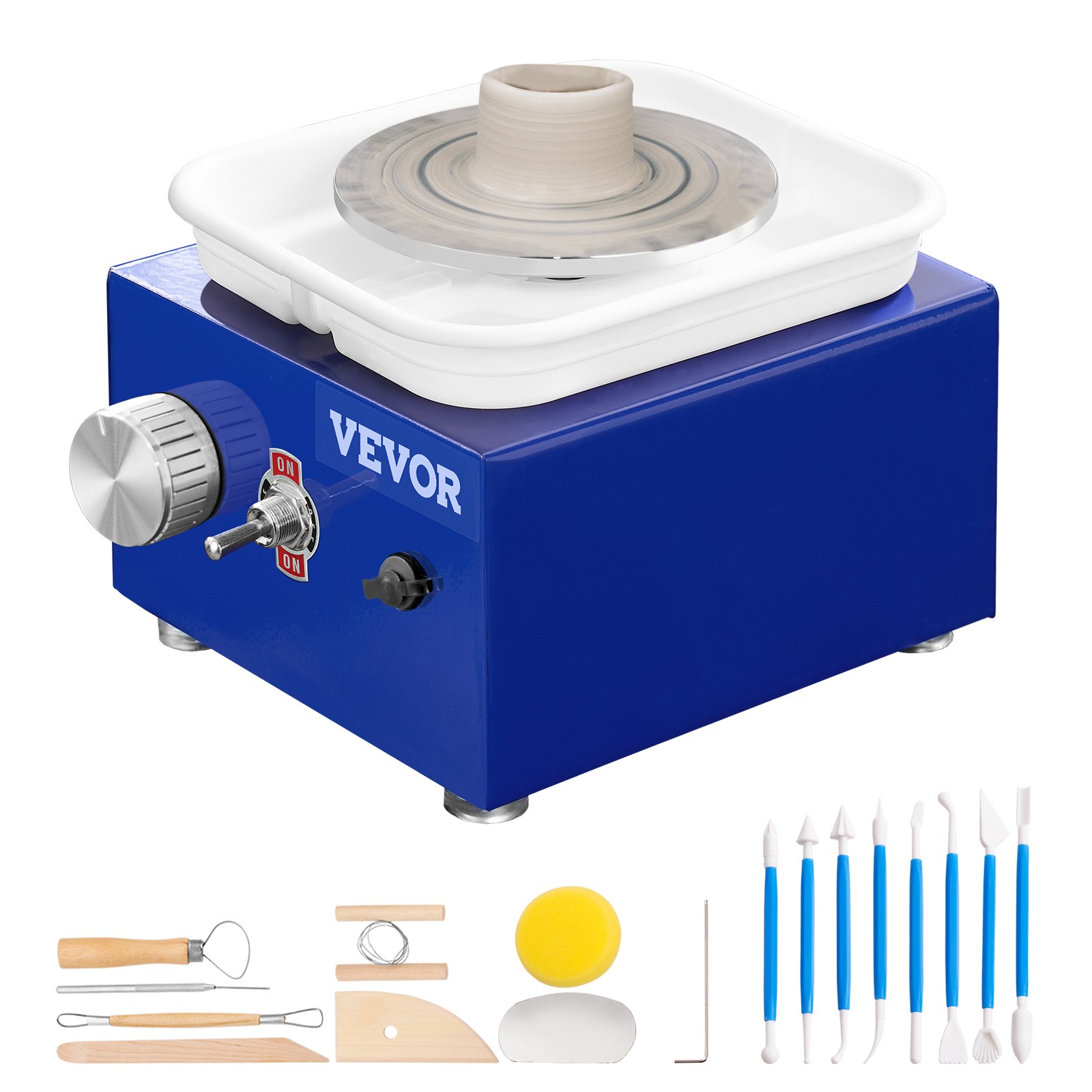

Photos from current listings. Actual item, color, and included accessories may vary.
Pottery Wheel Tool Buying Guide
Pottery wheel tools are the motorized throwing machines (not hand tools) that combine a rotating wheel head, speed control, and a work basin for centering and shaping clay. The core trade-off is motor torque and wheel-head mass versus portability and price: light 30W ABS-body units are for occasional small pieces, while heavier brushless motors with 10-inch+ heads and foot-pedal control hold torque under load for repeated centering. The decision rule: buy a foot-pedal, variable-speed wheel with a detachable basin and at least a 10-inch head if you throw weekly; skip high-RPM mini wheels for anything over 2 lb of clay.
Key takeaways
- Motor class separates tiers: 30-40W brushed motors suit 1-2 lb clay; 350W+ brushless DC motors maintain torque at low RPM for 5 lb+ centering.
- Wheel-head diameter of 10 in (25 cm) is the practical minimum for dinnerware; 14 in heads reduce re-centering on wide platters and bowls.
- Foot-pedal control with 0-300 RPM range beats knee-bar or single-speed switches for hands-free speed modulation while both hands are on the clay.
At a glance
- Category
- Pottery Wheels & Kilns
- Last updated
- Nov 28, 2026
Current offers
Highlights
- Motor class separates tiers: 30-40W brushed motors suit 1-2 lb clay; 350W+ brushless DC motors maintain torque at low RPM for 5 lb+ centering.
- Wheel-head diameter of 10 in (25 cm) is the practical minimum for dinnerware; 14 in heads reduce re-centering on wide platters and bowls.
- Foot-pedal control with 0-300 RPM range beats knee-bar or single-speed switches for hands-free speed modulation while both hands are on the clay.
- Detachable ABS or stainless basins make cleanup practical; fixed splash pans trap clay and are the main failure point on budget mini wheels.
Best use cases
- Best fit: home hobbyist throwing mugs and bowls weekly — pick a 10-14 in head, 350W+ brushless motor, foot pedal, detachable basin.
- Wrong fit: buying a 30W mini wheel with two small turntables for dinnerware — it stalls on clay over 2 lb; choose it only for sculpting, trimming, and small jewelry-scale pieces.
- Best fit: classroom or shared studio — choose a wheel with a sealed motor housing and removable basin rated for continuous 1-2 hour sessions.
- Wrong fit: expecting a mini wheel to double as a full-size throwing wheel — the 30W motor and small head limit clay weight and piece diameter; step up to a full-size 350W+ unit for real throwing.
Buying tips
- Match motor wattage to clay weight: 30-40W for under 2 lb, 100-250W for 2-5 lb, 350W+ brushless for 5 lb and up.
- Choose a wheel head of at least 10 in for plates and bowls; 14 in heads give more room for wide forms and bat pins.
- Insist on a foot pedal with continuous 0-300 RPM variable speed; stepped or single-speed controls make centering harder.
- Prefer detachable ABS or stainless basins over fixed pans; they clean faster and reduce clay buildup around the shaft.
Specs
| Motor Type | Brushed 30-40W vs Brushless 350W+ |
|---|---|
| Wheel Head Size | Mini <8 in / Standard 10-14 in |
| Speed Control | Foot pedal 0-300 RPM variable |
| Basin Type | Detachable ABS or stainless |
Related searches
What to check before buying
- Measure your workspace: a full-size wheel needs roughly a 2 ft x 2 ft footprint plus clearance for a stool and clay bucket.
- Confirm the wheel head accepts standard bat pins if you plan to use bats for production throwing.
- Check the plug and voltage standard for your region; most full-size wheels ship with regional plugs, mini wheels often use adapters.
- Verify the basin is detachable and the motor housing is sealed, since clay and water intrusion is the top cause of wheel failure.
FAQ
Data sources: eBay / Amazon listings and product attribute feeds. Updated Nov 28, 2026.
Some links on this page are affiliate links. If you buy after clicking one, we may earn a commission at no extra cost to you. This does not change which products appear here or their order. Affiliate disclosure.