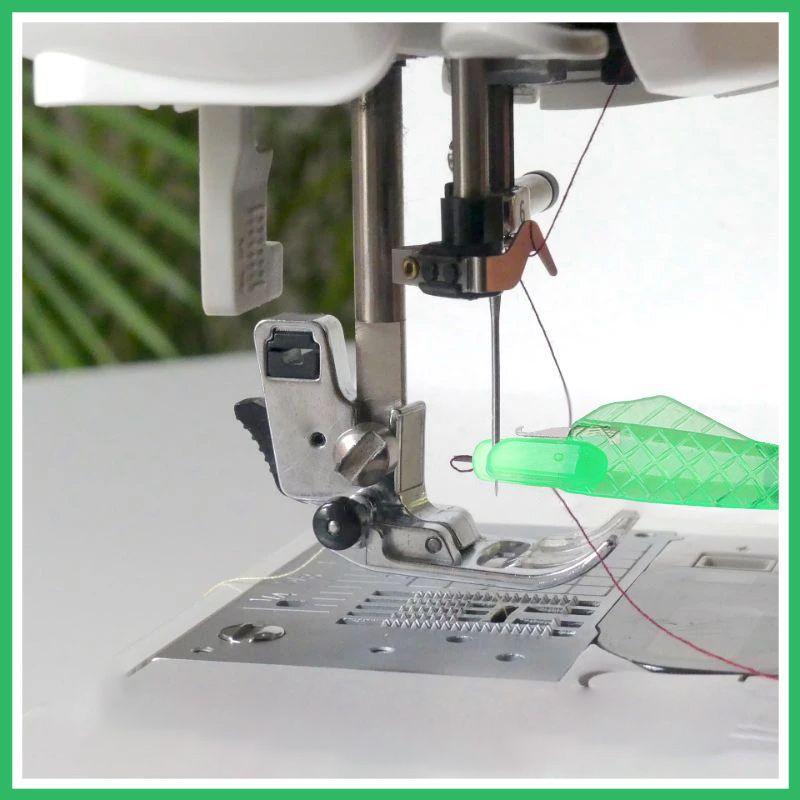

Photos from current listings. Actual item, color, and included accessories may vary.
Heavy Duty Sewing Machine Needle Buying Guide
Heavy-duty sewing machine needles are the hardened, large-gauge (90/14 to 130/21) or specialized-point needles required to penetrate denim, canvas, leather, and multiple layered fabrics without bending or snapping. The core trade-off is needle gauge and point geometry versus fabric weight and machine clearance: too thin a shaft flexes and breaks, too blunt a point tears weave instead of parting fibers. The decision rule is simple: match the needle system (130/705 H for home machines, DBx1 for industrial) and point type to the fabric's structure, then choose the smallest gauge that reliably penetrates without deflection.
Key takeaways
- Home-machine heavy duty needles use the 130/705 H flat-shank system; industrial machines require round-shank DBx1 or DCx1, and they are not interchangeable.
- Denim/jeans needs a 100/16 to 110/18 sharp point; leather needs a wedge or chisel point (often 110/18 to 130/21) that slices rather than punches; canvas favors 100/16 sharp.
- Needle gauge must escalate with fabric weight: 90/14 handles light canvas, 100/16 mid-weight denim, 110/18 heavy denim, and 120/21 to 130/21 thick leather and webbing.
At a glance
- Category
- Presser Feet, Notions & Threading
- Last updated
- Nov 28, 2026
Current offers
Highlights
- Home-machine heavy duty needles use the 130/705 H flat-shank system; industrial machines require round-shank DBx1 or DCx1, and they are not interchangeable.
- Denim/jeans needs a 100/16 to 110/18 sharp point; leather needs a wedge or chisel point (often 110/18 to 130/21) that slices rather than punches; canvas favors 100/16 sharp.
- Needle gauge must escalate with fabric weight: 90/14 handles light canvas, 100/16 mid-weight denim, 110/18 heavy denim, and 120/21 to 130/21 thick leather and webbing.
- Titanium-coated and reinforced heavy-duty needles resist heat and wear, but they still bend under lateral load if the machine lacks sufficient punch force.
Best use cases
- Best fit: sewing 12–14 oz denim on a home machine with a 100/16 or 110/18 sharp needle and a walking foot; skip standard 80/12 universal needles, which deflect and skip stitches.
- Best fit: leathercraft on an industrial flatbed using DBx1 110/18 wedge-point needles; wrong fit: using a home 130/705 H leather needle in an industrial machine, which causes timing and clearance issues.
- Best fit: layered canvas bags or upholstery with a 100/16 sharp or titanium needle; skip 90/14 if seams exceed four layers, because the shaft flexes and throws off hook timing.
- Best fit: occasional heavy seams on a domestic machine with a 90/14 or 100/16 heavy-duty pack; wrong fit: 130/21 needles in a low-punch-force plastic-frame machine, which stalls or breaks the needle clamp.
Buying tips
- Match the needle system first: 130/705 H for home flat-bed machines, DBx1 for industrial lockstitch, and DCx1 for coverstitch; wrong shank type will not seat or will strike the hook.
- Increase gauge with fabric weight: 90/14 for light canvas, 100/16 for mid denim, 110/18 for heavy denim and vinyl, 120/21–130/21 for thick leather and webbing.
- Choose point geometry by material: sharp for woven denim and canvas, wedge for leather, and ballpoint only for knits—never use a universal point on leather, which tears instead of slicing.
- Replace needles every 8–10 hours of heavy sewing or at the first skipped stitch; titanium-coated heavy-duty needles last longer but still dull at the point and should be changed on schedule.
Specs
| Needle System | 130/705 H home vs DBx1 industrial |
|---|---|
| Heavy Gauge Range | 90/14 to 130/21 |
| Point Type | Sharp, wedge, ballpoint |
| Coating | Standard chrome vs titanium |
Related searches
What to check before buying
- Confirm your machine's needle system and maximum needle gauge in the manual before buying—many home machines top out at 110/18 or 100/16.
- Measure your thickest seam stack: if it exceeds 1/4 inch (6 mm) of denim or leather, you need 110/18 or larger and a machine rated for it.
- Check presser foot clearance and needle plate slot: a 130/21 needle may not fit through a standard straight-stitch plate slot, requiring a zigzag or heavy-duty plate.
- Verify you have the companion foot and power for the job—a walking foot or roller foot plus a machine with sufficient punch force is required for consistent heavy-duty stitching.
FAQ
Data sources: eBay / Amazon listings and product attribute feeds. Updated Nov 28, 2026.
Some links on this page are affiliate links. If you buy after clicking one, we may earn a commission at no extra cost to you. This does not change which products appear here or their order. Affiliate disclosure.