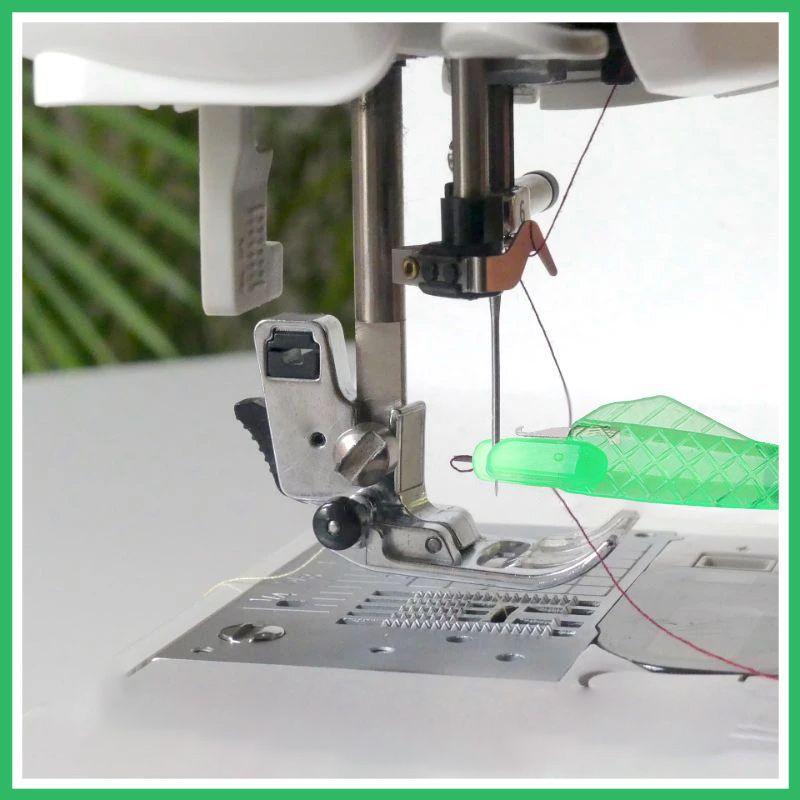

Photos from current listings. Actual item, color, and included accessories may vary.
Sewing Machine Needle Threader Buying Guide
A sewing machine needle threader is a small hand tool that pushes a fine wire loop through the needle eye and pulls thread back through, saving eyesight and time. The core trade-off is wire gauge and handle rigidity versus price: thin, flexible wire reaches small eyes but bends easily, while thicker wire survives tension but skips fine needles. Buy a metal-wire threader with a rigid handle for daily machine work, and skip flimsy all-plastic loops for anything beyond light hand-sewing.
Key takeaways
- Wire loop diameter determines needle compatibility: fine 0.3–0.4 mm wire fits size 60/8 to 70/10 machine needles, while thicker 0.5 mm wire only clears 80/12 and larger.
- All-plastic threaders use molded hooks that flex and snap under tension; metal-wire threaders with reinforced ferrules last for hundreds of threading cycles.
- Automatic needle threaders built into modern machines are model-specific assemblies that break or misalign; a standalone hand threader is the universal fallback for any machine.
At a glance
- Category
- Presser Feet, Notions & Threading
- Last updated
- Nov 28, 2026
Current offers
Highlights
- Wire loop diameter determines needle compatibility: fine 0.3–0.4 mm wire fits size 60/8 to 70/10 machine needles, while thicker 0.5 mm wire only clears 80/12 and larger.
- All-plastic threaders use molded hooks that flex and snap under tension; metal-wire threaders with reinforced ferrules last for hundreds of threading cycles.
- Automatic needle threaders built into modern machines are model-specific assemblies that break or misalign; a standalone hand threader is the universal fallback for any machine.
- Needle eye size varies by needle system — household 130/705 H needles have larger eyes than industrial DBx1 needles, so match threader wire to your needle type.
Best use cases
- Best fit: daily machine sewing with size 80/12–90/14 universal needles — pick a metal-wire threader with a 0.45–0.5 mm loop and a molded grip; skip all-plastic fish-style threaders that bend after a few uses.
- Best fit: fine needles (60/8–70/10) for quilting or lightweight fabrics — choose a fine-wire 0.3–0.4 mm threader or a needle with a larger eye; standard thick-wire threaders will not pass through.
- Wrong fit: serger and coverstitch machines — most needle threaders do not reach recessed looper or needle positions; use the machine's built-in threading path or a curved tweezer instead.
- Best fit: low-vision or arthritic sewers — pick a threader with a large ergonomic handle and a wire loop rated for 80/12+ needles; skip tiny keychain threaders that require fine motor control.
Buying tips
- Match wire gauge to your smallest needle: measure the needle eye or check the needle size — 0.4 mm wire clears 70/10, 0.5 mm wire needs 80/12 or larger.
- Choose a threader with a metal ferrule or crimped wire-to-handle joint; molded plastic-to-wire junctions are the first failure point.
- For machine needles, a threader with a 2–3 cm wire loop gives enough reach past the presser foot; shorter loops force you to remove the needle.
- Avoid decorative or novelty-shaped threaders (fish, flower) unless the wire is replaceable — the shape adds no function and often hides thin wire.
Specs
| Wire Gauge | 0.3–0.5 mm (fine to standard) |
|---|---|
| Handle Material | Metal ferrule / molded plastic |
| Needle Compatibility | 60/8–90/14 household needles |
| Loop Type | Fixed wire vs replaceable |
Related searches
What to check before buying
- Check your needle system and smallest needle size: household 130/705 H vs industrial DBx1 vs serger ELx705 — wire must fit the smallest eye you use.
- Measure clearance around the needle: with the presser foot down, you need 2–3 cm of straight access for the threader loop.
- Confirm the threader handle fits your grip and storage: large handles suit low-vision users but may not fit a small machine accessory box.
- For travel or class use, pick a threader with a capped wire or retractable loop to prevent bending in a bag.
FAQ
Data sources: eBay / Amazon listings and product attribute feeds. Updated Nov 28, 2026.
Some links on this page are affiliate links. If you buy after clicking one, we may earn a commission at no extra cost to you. This does not change which products appear here or their order. Affiliate disclosure.