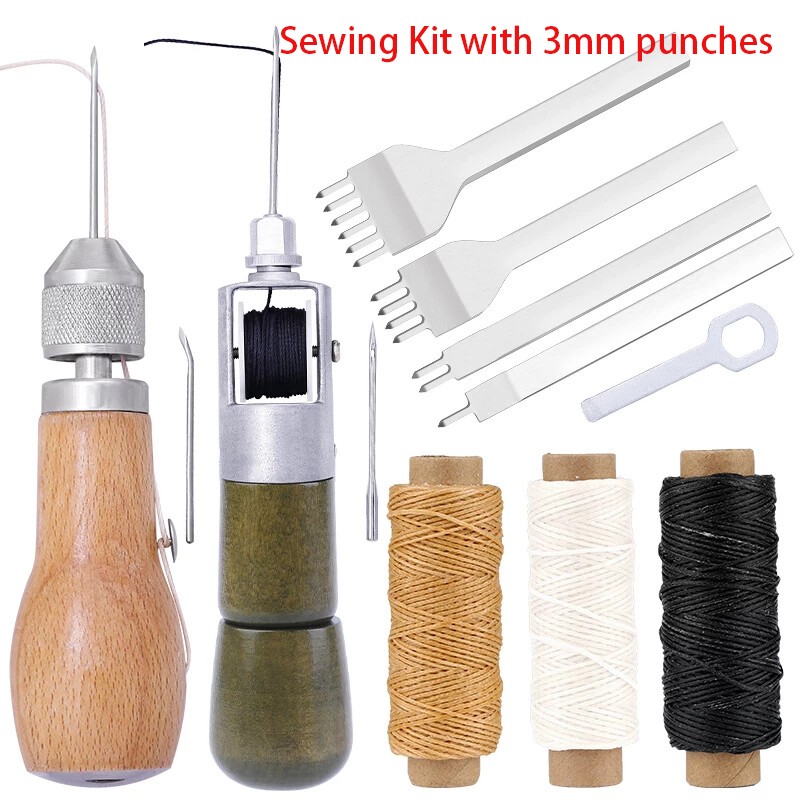

Photos from current listings. Actual item, color, and included accessories may vary.
Leather Sewing Awl Buying Guide
A leather sewing awl is a hand-stitching tool that combines a diamond-point or round blade with a built-in spool to lockstitch heavy leather, canvas, and webbing without a machine. The core trade-off is between stamped zinc-alloy heads that bend under load and hardened steel or machined aluminum bodies that hold tension for thick seams. Choose a hardened-steel awl with a locking spool and replaceable needles if you stitch belts, sheaths, or saddlery; skip budget pot-metal kits for anything thicker than 2 mm.
Key takeaways
- Awl heads are either die-cast zinc alloy (soft, strips threads under load) or hardened steel/machined aluminum (retains needle clamp torque).
- Speedy-stitcher models use a two-needle lockstitch that creates a secure chain on both faces, unlike single-needle awls that only pierce.
- Needle geometry matters: diamond-point blades pierce and widen holes for saddlery; round-point needles suit pre-punched holes and canvas.
At a glance
- Category
- Leather Stitching Tools
- Last updated
- Nov 23, 2026
Current offers
Highlights
- Awl heads are either die-cast zinc alloy (soft, strips threads under load) or hardened steel/machined aluminum (retains needle clamp torque).
- Speedy-stitcher models use a two-needle lockstitch that creates a secure chain on both faces, unlike single-needle awls that only pierce.
- Needle geometry matters: diamond-point blades pierce and widen holes for saddlery; round-point needles suit pre-punched holes and canvas.
- Thread capacity is set by spool diameter and thread diameter—waxed polyester 0.8–1.0 mm is the standard for outdoor leather repairs.
Best use cases
- Best fit: repairing belts, sheaths, harnesses, and bags 2–5 mm thick—pick a hardened-steel speedy awl with a locking spool and 1.0 mm waxed thread.
- Best fit: canvas, upholstery, and webbing repairs—choose a round-point needle awl with a larger spool to run heavier bonded nylon.
- Wrong fit: fine leathercraft or shoe upper work under 2 mm—use saddler's needles and a stitching pony instead; an awl will oversized the holes.
- Wrong fit: high-volume production or long seams over 30 cm—a hand awl is slower and less consistent than a portable pony and machine stitch.
Buying tips
- Match needle diameter to thread: a 1.0 mm waxed thread needs a needle hole roughly 1.2 mm to pass without fraying.
- Pick a locking spool tensioner—spring or screw tension prevents thread backlash and loose stitches on thick seams.
- Choose hardened steel or machined aluminum over painted zinc alloy; zinc heads deform at the needle clamp under 5 kg of pull.
- Confirm the awl accepts standard replaceable needles (common 1.5–2 mm shank) so you can switch point geometry without a new tool.
Specs
| Body Material | Hardened steel vs zinc alloy |
|---|---|
| Stitch Type | Two-needle lockstitch vs pierce-only |
| Needle Point | Diamond vs round point |
| Thread Capacity | 0.6–1.2 mm waxed polyester |
Related searches
What to check before buying
- Measure your thickest leather: awls handle 2–6 mm comfortably; above 6 mm use a pony and saddler's needles.
- Check thread compatibility: waxed polyester 0.8–1.0 mm fits most speedy awls; bonded nylon needs a larger spool.
- Verify replacement needles are available in diamond and round points for your awl's shank size.
- Plan a cutting mat and stitching pony—an awl requires two free hands to tension the lockstitch.
FAQ
Data sources: eBay / Amazon listings and product attribute feeds. Updated Nov 23, 2026.
Some links on this page are affiliate links. If you buy after clicking one, we may earn a commission at no extra cost to you. This does not change which products appear here or their order. Affiliate disclosure.