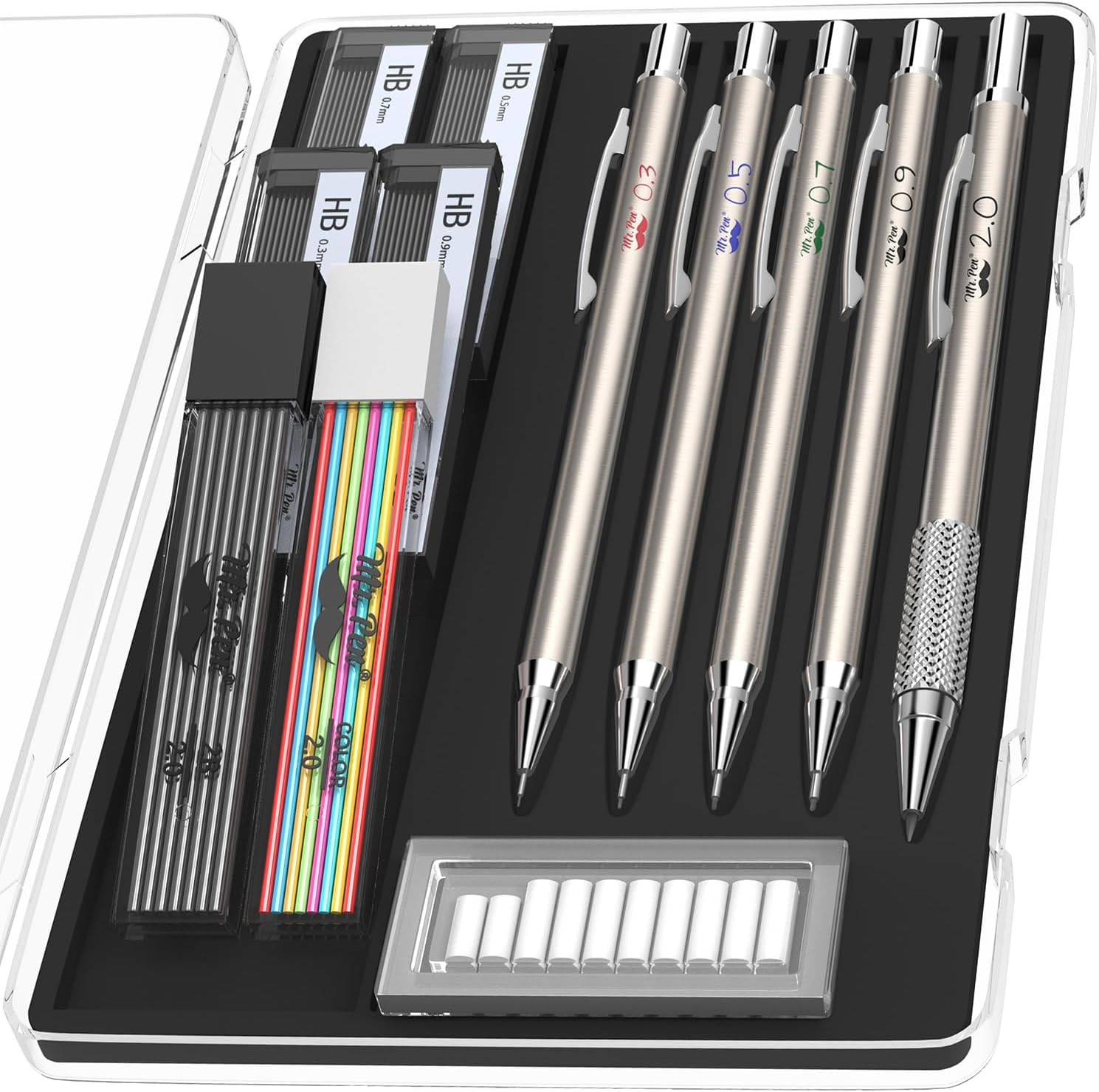

Photos from current listings. Actual item, color, and included accessories may vary.
Mechanical Pencil Buying Guide
Mechanical pencils are refillable lead-advance tools defined by lead diameter, clutch mechanism, and body construction — the trade-off is precision and durability versus comfort and lead economy. The decisive rule: choose a metal clutch (brass or metal-jaw) in 0.5 mm or 0.7 mm for daily writing, and a fixed-sleeve or retractable-sleeve drafting body in 0.3–0.9 mm for drawing; skip all-plastic clutches and unsealed lead tubes for heavy daily use.
Key takeaways
- Clutch type is the durability bottleneck: brass or metal-jaw clutches hold 0.3–0.9 mm lead without slippage, while molded-plastic clutches wear and drop lead under pressure.
- Lead diameter sets the job: 0.3 mm for fine hatching and detail, 0.5 mm for general writing and sketching, 0.7 mm for bold writing and shading, 0.9 mm for soft graphite and construction lines.
- Drafting pencils use a fixed 2–4 mm guide sleeve that protects lead at low angles; writing pencils use a retractable or conical sleeve that won't tear paper or pockets.
At a glance
- Category
- Art Supplies
- Last updated
- Nov 28, 2026
Current offers
Highlights
- Clutch type is the durability bottleneck: brass or metal-jaw clutches hold 0.3–0.9 mm lead without slippage, while molded-plastic clutches wear and drop lead under pressure.
- Lead diameter sets the job: 0.3 mm for fine hatching and detail, 0.5 mm for general writing and sketching, 0.7 mm for bold writing and shading, 0.9 mm for soft graphite and construction lines.
- Drafting pencils use a fixed 2–4 mm guide sleeve that protects lead at low angles; writing pencils use a retractable or conical sleeve that won't tear paper or pockets.
- Body material drives balance and lifespan: brass or aluminum barrels resist cracking and add tip-forward weight; ABS plastic bodies are lighter but flex and strip at the clutch threads.
Best use cases
- Best for daily note-taking and office writing: pick a 0.5 mm or 0.7 mm retractable-sleeve pencil with a metal clutch and rubber grip — skip 0.3 mm drafting pencils, whose fragile lead snaps under writing pressure.
- Best for drawing, sketching, and drafting: pick a 0.3–0.9 mm fixed-sleeve metal-body pencil with a knurled grip and lead-grade indicator — skip plastic-bodied pencils with conical sleeves for low-angle shading.
- Best for students and heavy-handed writers: pick a 0.7 mm or 0.9 mm lead size with a cushioned grip and a large eraser — skip 0.5 mm slim drafting pencils, which feel scratchy and snap lead under heavy pressure.
- Wrong fit for pocket carry and travel: full-length fixed-sleeve drafting pencils puncture pockets and bags; choose a retractable-sleeve or capped model instead.
Buying tips
- Match lead diameter to task: 0.5 mm is the all-round default, 0.7 mm suits heavy-handed writers, 0.3 mm is for fine detail only, and 0.9 mm is for soft 2B–4B shading.
- Check clutch material before anything else: brass or metal jaws outlast plastic clutches by years under daily load; plastic clutches are acceptable only for light, occasional use.
- Choose a fixed 2–4 mm guide sleeve for drafting and a retractable sleeve for writing — fixed sleeves protect lead at low angles but are sharp in a pocket.
- Confirm lead refill compatibility: standard 0.5/0.7 mm leads fit most pencils, but 0.3 mm and 0.9 mm require matching diameter tubes and some pencils accept only proprietary lead lengths.
Specs
| Lead Diameter | 0.3 / 0.5 / 0.7 / 0.9 mm |
|---|---|
| Clutch Type | Brass or metal-jaw vs plastic |
| Sleeve Style | Fixed guide vs retractable |
| Body Material | Brass / aluminum vs ABS plastic |
Related searches
What to check before buying
- Measure your hand span and grip: barrels 9–11 mm suit most adults, 8–9 mm suits smaller hands, and triangular or rubber grips reduce fatigue for long writing sessions.
- Confirm your lead refill standard: 0.5 mm and 0.7 mm leads are universal, while 0.3 mm and 0.9 mm leads must match the pencil's stated diameter.
- Decide between fixed-sleeve drafting (sharp, pocket-unsafe) and retractable-sleeve writing (pocket-safe, less precise at low angles) before choosing a body style.
- Check whether an eraser and eraser refills are included or standard-size — retractable erasers and large block erasers wear out and need matching replacements.
FAQ
Data sources: eBay / Amazon listings and product attribute feeds. Updated Nov 28, 2026.
Some links on this page are affiliate links. If you buy after clicking one, we may earn a commission at no extra cost to you. This does not change which products appear here or their order. Affiliate disclosure.