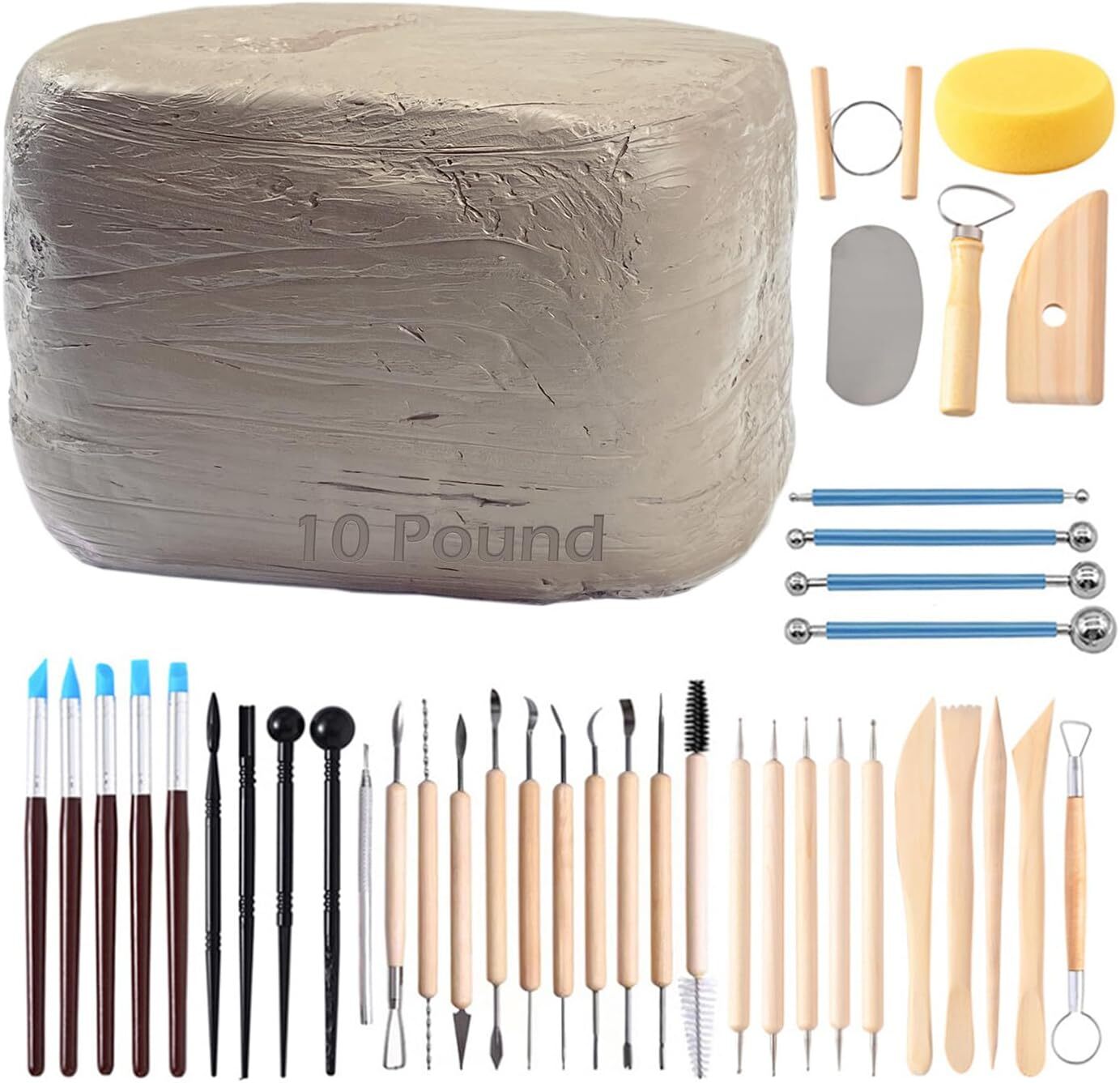

Photos from current listings. Actual item, color, and included accessories may vary.
Air Dry Clay Buying Guide
Air dry clay is a water-based, non-fired modeling material that hardens at room temperature, eliminating the need for a kiln. The core trade-off is between fine-particle, fiber-reinforced bodies that resist cracking and cheap, high-shrinkage formulas that warp or crumble. Choose a fiber-reinforced, low-shrink body for structural pieces; skip generic 'modeling clay' only if you need wheel-thrown, watertight vessels.
Key takeaways
- Fiber-reinforced air dry clay (paper or nylon fibers) reduces drying cracks by distributing shrinkage stress; unreinforced bodies crack above 8–10% shrinkage.
- Shrinkage rates range from 3–5% for premium fiber bodies to 10–15% for budget kaolin-heavy clays; higher shrinkage demands slower drying and larger armature clearance.
- Surface hardness after full cure (48–72 hours at 1/4-inch thickness) varies from chalky (low binder) to near-plaster (high PVA/acrylic binder); binder content dictates sandability and water resistance.
At a glance
- Category
- Pottery Clay & Ceramic Bodies
- Last updated
- Nov 28, 2026
Current offers
Highlights
- Fiber-reinforced air dry clay (paper or nylon fibers) reduces drying cracks by distributing shrinkage stress; unreinforced bodies crack above 8–10% shrinkage.
- Shrinkage rates range from 3–5% for premium fiber bodies to 10–15% for budget kaolin-heavy clays; higher shrinkage demands slower drying and larger armature clearance.
- Surface hardness after full cure (48–72 hours at 1/4-inch thickness) varies from chalky (low binder) to near-plaster (high PVA/acrylic binder); binder content dictates sandability and water resistance.
- Pottery-wheel use requires a plastic, low-tack body with 15–20% water content; most air dry clays are too sticky or lack green strength for throwing and are hand-building only.
Best use cases
- Best fit: hand-built sculpting, figurines, and coasters — pick a fiber-reinforced 10 lb block with a 3–5% shrinkage rating and sealed foil bag.
- Wrong fit: wheel-thrown mugs or functional dinnerware — air dry clay is not food-safe or waterproof unless sealed with food-grade epoxy, and it lacks the plasticity for throwing.
- Best fit: classroom or kid projects — choose a pre-colored, non-staining body in 5–10 lb resealable tubs; skip hard 10 lb blocks that require wedging and water addition.
- Wrong fit: outdoor garden sculptures in freeze-thaw climates — standard air dry clay absorbs water and spalls; use exterior-grade epoxy putty or fired stoneware instead.
Buying tips
- Buy by shrinkage spec: for armature-wrapped pieces, keep clay shrinkage under 5% so the core does not telegraph through; budget clays at 12% need double the drying time.
- Match package weight to project volume: a 10 lb block yields roughly 300 cubic inches (a 6x6x8-inch solid form); buy 2 lb sticks for small figurines to avoid dried-out leftovers.
- Check fiber content on the label: paper-fiber bodies sand smoothly and join with slip; nylon-fiber bodies are stronger but fuzz when carved — pick paper for detail, nylon for structural spans.
- For wheel use, only buy clays explicitly labeled 'throwable' or 'wheel-safe' with a plastic consistency; standard air dry clay tears on the wheel and cannot be recentered.
Specs
| Shrinkage Rate | 3–5% fiber vs 10–15% budget |
|---|---|
| Fiber Reinforcement | Paper fiber vs nylon fiber vs none |
| Wheel Suitability | Hand-build only vs throwable |
| Cure Time | 48–72 hr at 1/4 inch thickness |
Related searches
What to check before buying
- Measure your armature or mold cavity: clay volume shrinks 3–15%, so a 6-inch mold needs a 6.2–6.9-inch starting form depending on the body's shrinkage rate.
- Confirm your workspace humidity: air dry clay cures best at 40–60% RH; in dry climates mist daily or drape plastic to slow drying and prevent surface cracks.
- Check tool compatibility: 40-piece tool sets include wooden modeling tools and wire loop tools; for wheel work you also need a bat system and sponge, not just sculpting tools.
- Verify sealant plan: unsealed air dry clay is not waterproof; for cups or outdoor pieces, budget for food-grade epoxy or exterior polyurethane before buying the clay.
FAQ
Data sources: eBay / Amazon listings and product attribute feeds. Updated Nov 28, 2026.
Some links on this page are affiliate links. If you buy after clicking one, we may earn a commission at no extra cost to you. This does not change which products appear here or their order. Affiliate disclosure.