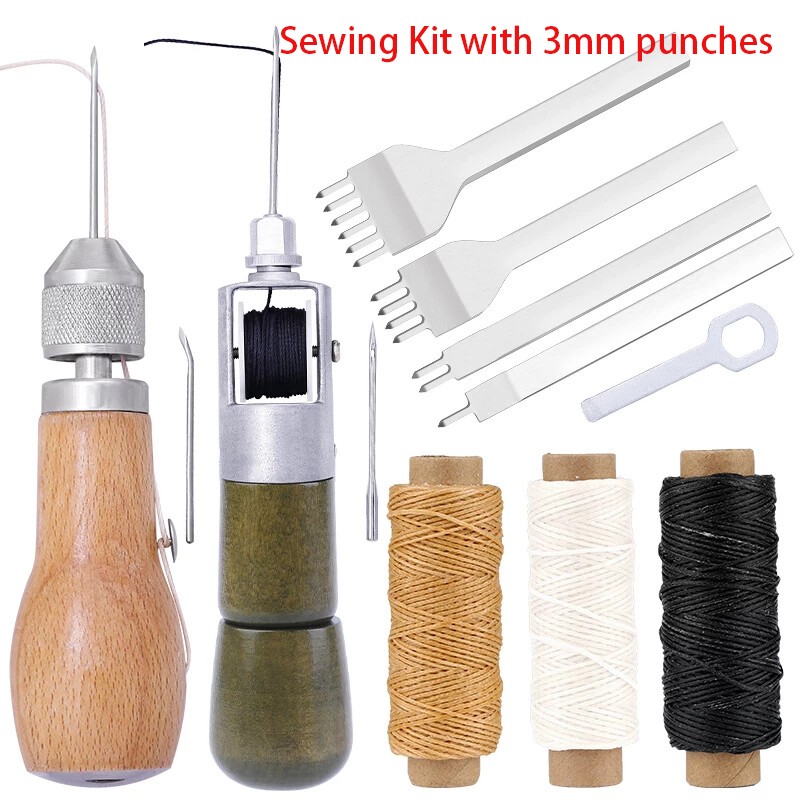

Photos from current listings. Actual item, color, and included accessories may vary.
Heavy Duty Sewing Awl Buying Guide
A heavy-duty sewing awl is a hand tool that drives a lockstitch through thick leather, canvas, or webbing by combining a piercing awl with a spool of waxed thread. The core trade-off is between a fixed, robust shaft that resists bending under high force and a hollow-handle design that stores thread but can flex or strip at the chuck. Choose a solid-steel or hardened chuck awl with a replaceable needle for repeatable durability; skip hollow-handle or plastic-bodied awls if you regularly pierce 4 mm+ leather.
Key takeaways
- Speedy Stitcher-style hollow-handle awls use a chuck that grips the needle; hardened steel chucks hold needles true, while stamped or plastic chucks slip and wobble under load.
- Needle geometry matters: a diamond or triangular point cuts a clean hole in leather, while a round point separates fibers and is better for canvas and webbing.
- Shaft diameter and material determine bending resistance — solid steel shafts of 5-6 mm diameter resist flex far better than hollow tube handles in 2-3 mm wall thickness.
At a glance
- Category
- Leather Stitching Tools
- Last updated
- Nov 23, 2026
Current offers
Highlights
- Speedy Stitcher-style hollow-handle awls use a chuck that grips the needle; hardened steel chucks hold needles true, while stamped or plastic chucks slip and wobble under load.
- Needle geometry matters: a diamond or triangular point cuts a clean hole in leather, while a round point separates fibers and is better for canvas and webbing.
- Shaft diameter and material determine bending resistance — solid steel shafts of 5-6 mm diameter resist flex far better than hollow tube handles in 2-3 mm wall thickness.
- Thread capacity and waxed thread size (typically #69 to #138 bonded nylon) set the maximum stitch strength; hollow handles accept small bobbins, while spool holders allow larger thread runs.
Best use cases
- Best fit: saddle stitching or repairing 3-5 mm veg-tan leather belts and holsters — pick a solid-shaft awl with a diamond needle and a locking chuck that accepts #138 bonded nylon thread.
- Best fit: canvas tents, sails, and heavy webbing repairs — choose a hollow-handle awl with a round-point needle and a bobbin that holds at least 10 m of #69 waxed thread for portability.
- Wrong fit: lightweight garment or upholstery fabric — a heavy-duty awl enlarges holes and weakens seams; use a domestic sewing machine or a fine stitching awl instead.
- Wrong fit: high-volume production stitching — a manual awl is slow and inconsistent for repeated long seams; a harness or shoe patcher sewing machine is the correct tool.
Buying tips
- Match needle point to material: diamond/triangular point for leather (clean slit), round point for woven canvas and webbing (prevents fiber tear-out).
- Check chuck type: a hardened steel 3-jaw chuck or collet holds needles without slipping; avoid stamped sheet-metal or plastic friction chucks that deform under piercing force.
- Verify thread compatibility: the awl should accept standard bonded nylon sizes #69 (heavy canvas) through #138 (thick leather); smaller bobbins limit you to short seams.
- Prioritize a replaceable needle system: needles dull and snap; a tool with standard-gauge replacement needles (e.g., 1.5-2 mm shank) remains usable long-term.
Specs
| Handle Type | Hollow storage vs solid shaft |
|---|---|
| Chuck Material | Hardened steel vs stamped/plastic |
| Needle Point | Diamond (leather) / round (canvas) |
| Thread Range | #69 to #138 bonded nylon |
Related searches
What to check before buying
- Measure your thickest material: if routinely over 4 mm leather, choose a solid steel shaft awl with a reinforced chuck; hollow handles may flex or crush.
- Check thread spool fit: confirm the handle or spool pin accommodates the thread bobbin size you plan to use (standard bobbins are about 25 mm diameter).
- Confirm replacement needle availability: the awl should use a standard needle shank diameter (commonly 1.5-2 mm) so you can reorder needles without matching a proprietary part.
- Assess hand fatigue: for long sessions, a larger-diameter handle or a palm pad reduces pressure; hollow-handle awls are lighter but can be slippery when waxed.
FAQ
Data sources: eBay / Amazon listings and product attribute feeds. Updated Nov 23, 2026.
Some links on this page are affiliate links. If you buy after clicking one, we may earn a commission at no extra cost to you. This does not change which products appear here or their order. Affiliate disclosure.