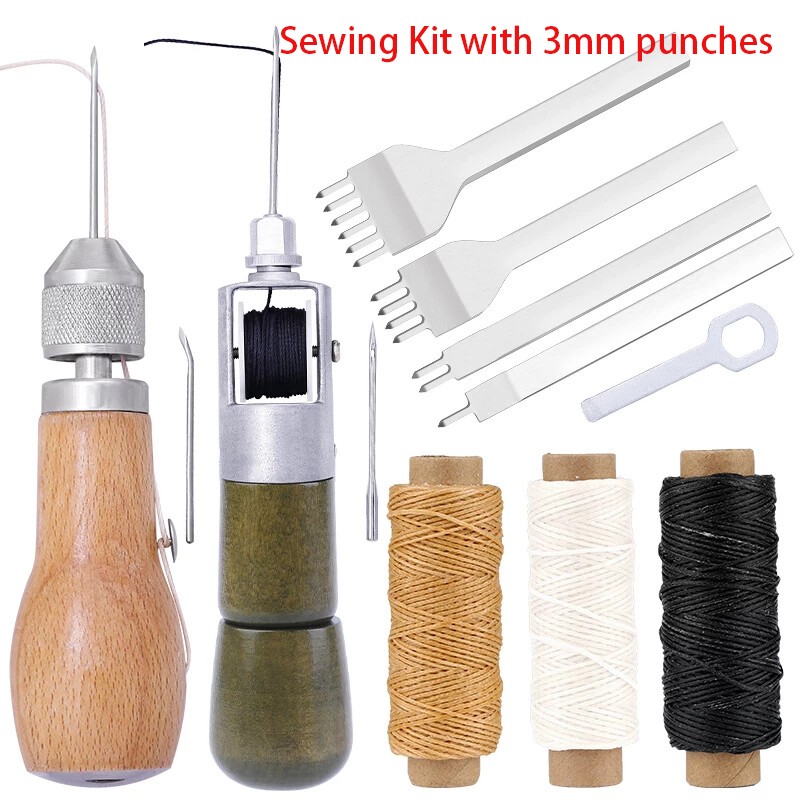

Photos from current listings. Actual item, color, and included accessories may vary.
Leather Awl Buying Guide
A leather awl is the piercing and stitching hand tool that separates clean hole-making from stretched, torn leather. The core trade-off is hardened steel geometry (polished diamond/flat blades, secure haft) versus soft stamped metal that dulls or snaps. Buy is decided by leather weight and stitch type: pick a hafted diamond awl for saddle stitching, a speedy-stitch hook awl only for quick repairs and thick thread.
Key takeaways
- Diamond-section blades (4 sharp edges, tapering point) pierce and widen holes for saddle stitching; round or flat blades are for lacing and edge work, not precise stitching.
- Hardened high-carbon or stainless steel holds an edge through 2-4 mm veg-tan; soft stamped alloy awls deform at the tip and drag in the hole.
- Speedy-stitch (hook) awls use a hollow needle and locking nut to pull waxed thread through both layers, replacing two needles and a stitching pony.
At a glance
- Category
- Leather Stitching Tools
- Last updated
- Nov 23, 2026
Current offers
Highlights
- Diamond-section blades (4 sharp edges, tapering point) pierce and widen holes for saddle stitching; round or flat blades are for lacing and edge work, not precise stitching.
- Hardened high-carbon or stainless steel holds an edge through 2-4 mm veg-tan; soft stamped alloy awls deform at the tip and drag in the hole.
- Speedy-stitch (hook) awls use a hollow needle and locking nut to pull waxed thread through both layers, replacing two needles and a stitching pony.
- Haft diameter and length matter: 8-12 mm ferrules with a 70-90 mm blade give control; loose or glued ferrules wobble and spin under pressure.
Best use cases
- Saddle stitching belts, holsters, or bags: use a diamond awl with polished taper and a hardwood or knurled haft; skip hook awls that widen holes unevenly.
- Quick field repairs on 1-2 mm leather with heavy waxed thread: a speedy-stitch hook awl kit is the right pick; skip it for visible decorative stitching where hole spacing must be exact.
- Lacing and edge finishing: choose a flat or scratch awl; skip diamond awls that cut fibers and weaken edge lacing.
- Thin garment or chrome-tan leather under 1 mm: a fine 1.5-2 mm diamond tip or a stitching chisel plus awl is required; skip heavy 3 mm blades that tear lightweight hides.
Buying tips
- Match blade thickness to leather: 1.5-2 mm tip for 1-2 mm leather, 2.5-3 mm for 3-4 mm veg-tan; oversized blades stretch holes and loosen stitches.
- Choose high-carbon steel for edge retention and easy honing; stainless resists rust but needs polished geometry to avoid drag.
- Check haft attachment: a through-tang or pinned ferrule beats glued-in blades, which loosen with repeated pulling.
- For hook awls, confirm the needle accepts 0.8-1.2 mm waxed thread and includes a locking nut; thinner thread slips and thicker thread jams.
Specs
| Blade Geometry | Diamond / Flat / Round / Hook |
|---|---|
| Blade Tip Width | 1.5-3 mm (leather weight matched) |
| Steel Type | High-carbon / Stainless hardened |
| Haft Fit | Pinned or through-tang ferrule |
Related searches
What to check before buying
- Measure leather weight in mm/oz: under 2 mm needs a fine awl, 3-4 mm needs a sturdy diamond blade.
- Confirm stitch spacing: 4-5 mm pricking irons pair with 2-2.5 mm awl tips for consistent holes.
- Verify thread diameter and type (flat waxed polyester vs nylon) fits the awl eye or hook channel.
- Check that a stitching pony or clamp is available; hook awls and saddle stitching both need two free hands.
FAQ
Data sources: eBay / Amazon listings and product attribute feeds. Updated Nov 23, 2026.
Some links on this page are affiliate links. If you buy after clicking one, we may earn a commission at no extra cost to you. This does not change which products appear here or their order. Affiliate disclosure.