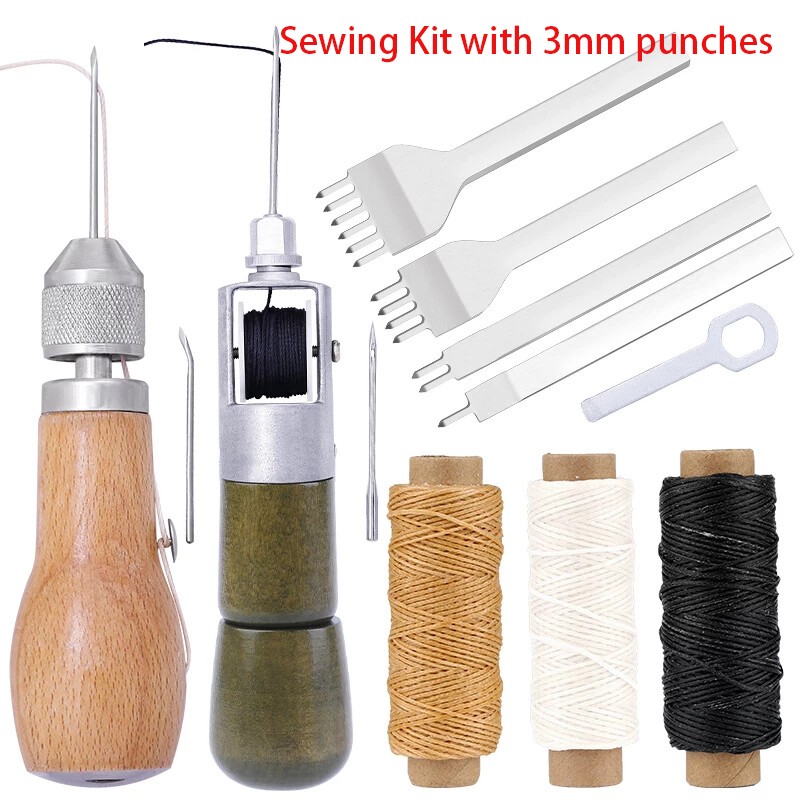

Photos from current listings. Actual item, color, and included accessories may vary.
Leather Awl Kit Buying Guide
A leather awl kit is a compact hand-stitching system built around a awl (usually a speedy stitcher or diamond-point awl) plus waxed thread and punches for repairing or building leather goods. The key trade-off is between hollow-handle speedy awls that feed thread from the handle and traditional awl hafts paired with separate needles, which changes stitch speed, thread capacity, and control. Choose a kit with hardened steel awl points, a locking chuck, and waxed polyester thread for durable repairs; skip kits with soft zinc-alloy handles or unwaxed cotton thread that fray and snap under load.
Key takeaways
- Hollow-handle speedy awls feed thread from inside the handle via a locking chuck, enabling one-handed lockstitch on thick leather; traditional awls require separate needles and two-handed stitching.
- Hardened steel awl points (diamond or chisel profile) pierce 2-4 mm veg-tan without bending; soft zinc-alloy or unhardened points roll and blunt after a few holes.
- Waxed polyester thread (typically 0.8-1.2 mm) resists abrasion and UV, while unwaxed cotton thread frays in the eye and weakens at stitch corners.
At a glance
- Category
- Leather Stitching Tools
- Last updated
- Nov 23, 2026
Current offers
Highlights
- Hollow-handle speedy awls feed thread from inside the handle via a locking chuck, enabling one-handed lockstitch on thick leather; traditional awls require separate needles and two-handed stitching.
- Hardened steel awl points (diamond or chisel profile) pierce 2-4 mm veg-tan without bending; soft zinc-alloy or unhardened points roll and blunt after a few holes.
- Waxed polyester thread (typically 0.8-1.2 mm) resists abrasion and UV, while unwaxed cotton thread frays in the eye and weakens at stitch corners.
- Kit punch sizes (2, 3, 4 mm prong spacing) set stitch length; 3 mm prongs suit wallets and watch straps, 4 mm suits belts and bags with heavier thread.
Best use cases
- Best fit: repairing a torn leather bag or boot seam—pick a hollow-handle speedy awl kit with 1 mm waxed polyester thread and a 3 mm prong punch for tight, even stitches.
- Best fit: building small leather goods from scratch—choose a kit with a diamond-point awl, 2 mm and 3 mm prong punches, and harness needles so you can saddle-stitch by hand.
- Wrong fit: production-volume stitching or thick 6 mm+ saddle leather—a hand awl kit lacks the leverage; use a stitching pony and heavy awl haft or a sewing machine instead.
- Wrong fit: delicate garment leather or suede—speedy awl chucks and 4 mm prongs tear thin hides; pick a fine 2 mm prong punch and a slim awl needle instead.
Buying tips
- Match punch prong spacing to thread diameter: 2 mm prongs for 0.6-0.8 mm thread, 3 mm for 0.8-1.0 mm, 4 mm for 1.0-1.2 mm; mismatched spacing looks loose or crowds holes.
- Choose hardened steel awl points and a brass or steel collet chuck; magnetic or plastic chucks slip under pressure and strip the thread channel.
- For speedy awls, confirm the handle accepts standard 1 mm waxed thread spools and includes a spare needle; proprietary refills limit repairability.
- Kit prong punches should be heat-treated (HRC 50+) and aligned in a straight row; misaligned or soft prongs bend and produce wandering stitch lines.
Specs
| Awl Type | Hollow-handle speedy vs traditional haft |
|---|---|
| Thread Material | Waxed polyester 0.8-1.2 mm |
| Prong Spacing | 2 / 3 / 4 mm stitch length |
| Max Leather | 3-4 mm per pass (hand awl) |
Related searches
What to check before buying
- Leather thickness: measure your workpiece; speedy awls handle up to 4 mm, while thicker straps need a traditional awl haft and stitching pony.
- Thread capacity: hollow-handle awls hold 10-20 m of 1 mm waxed thread; confirm the spool fits inside the handle before relying on one-handed stitching.
- Prong punch compatibility: check that the kit's prong spacing matches your desired stitch length and that replacement punches are standard 2/3/4 mm sizes.
- Work surface: a cutting mat or poundo board is required for prong punches; skipping it dulls prongs and damages tables.
FAQ
Data sources: eBay / Amazon listings and product attribute feeds. Updated Nov 23, 2026.
Some links on this page are affiliate links. If you buy after clicking one, we may earn a commission at no extra cost to you. This does not change which products appear here or their order. Affiliate disclosure.