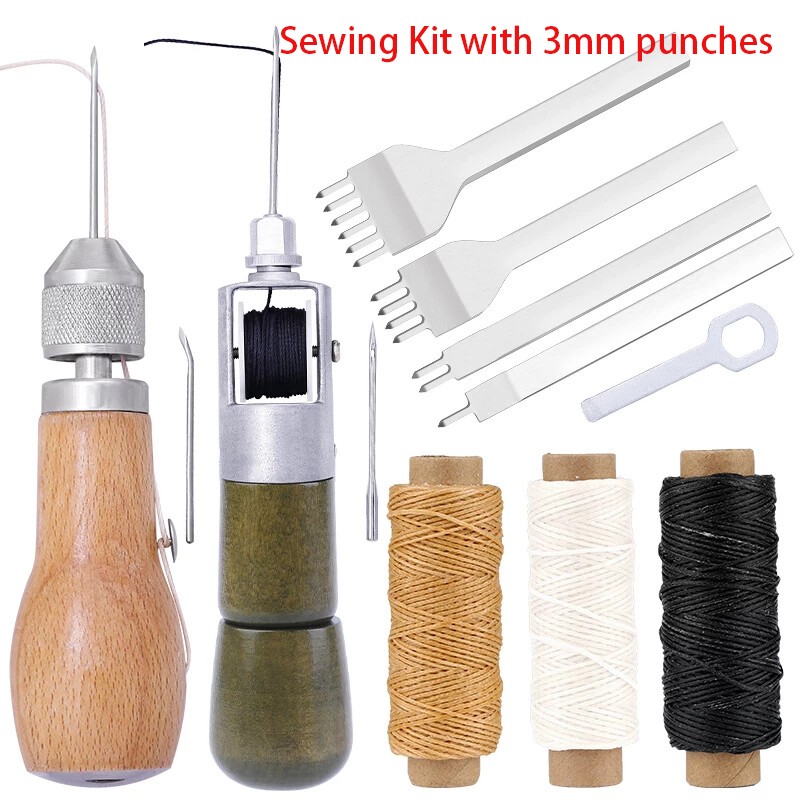

Photos from current listings. Actual item, color, and included accessories may vary.
Leather Sewing Punch Buying Guide
A leather sewing punch is a pricking iron or stitching chisel that pre-punches uniform holes for hand-sewn leather goods, where the critical trade-off is prong geometry and steel hardness versus cost. Durable punches use hardened, polished carbon or stainless steel with tapered diamond or round prongs that release cleanly; cheap soft-steel punches bend, mushroom, or tear fibers. Choose based on stitch pitch (SPI), prong count, and whether you need diamond chisels for saddle stitching or round-hole punches for lacing.
Key takeaways
- Diamond vs round prongs: diamond chisels set slanted stitches for saddle stitching; round punches create straight holes for lacing, rivets, or machine-style seams.
- Pitch is measured in stitches per inch (SPI); common leathercraft pitches are 4mm (~6 SPI), 3.85mm (~6.5 SPI), and 3mm (~8.5 SPI), with finer pitch for small goods.
- Prong count (1, 2, 4, 6) controls corner accuracy and line length; 2-prong punches are essential for curves and corners, 4- and 6-prong for long straight runs.
At a glance
- Category
- Leather Stitching Tools
- Last updated
- Nov 23, 2026
Current offers
Highlights
- Diamond vs round prongs: diamond chisels set slanted stitches for saddle stitching; round punches create straight holes for lacing, rivets, or machine-style seams.
- Pitch is measured in stitches per inch (SPI); common leathercraft pitches are 4mm (~6 SPI), 3.85mm (~6.5 SPI), and 3mm (~8.5 SPI), with finer pitch for small goods.
- Prong count (1, 2, 4, 6) controls corner accuracy and line length; 2-prong punches are essential for curves and corners, 4- and 6-prong for long straight runs.
- Hardened steel rated around 55-60 HRC holds an edge and resists bending; polished flutes and tapered tips reduce friction and leather tear-out.
Best use cases
- Best fit: 4-prong 3.85mm or 4mm diamond chisel set for wallets, belts, and saddle stitching with 0.6-0.8mm thread; skip 6-prong on tight curves.
- Best fit: 2-prong punch plus single-prong awl for corners, gussets, and strap ends where a 4-prong will overrun the edge.
- Best fit: round-hole punch pliers or rotary punch for quick belt holes and hardware; skip diamond chisels if you need perfect circles for lacing.
- Wrong fit: soft-steel budget punches under heavy mallet use on thick veg-tan; they mushroom and bind, tearing holes instead of cutting cleanly.
Buying tips
- Match pitch to thread: 4mm/3.85mm for 0.6-0.8mm thread, 3mm for 0.4-0.6mm thread on watch straps and card holders.
- Buy a set spanning 2, 4, and 6 prongs in one pitch; single-prong only for starting holes and repairs.
- Check steel hardness and tip taper: hardened 55-60 HRC with polished flutes releases leather without stretching holes.
- Verify shank diameter and handle compatibility; most chisels use round shanks that fit standard collets or wooden handles.
Specs
| Prong Type | Diamond chisel vs round hole |
|---|---|
| Stitch Pitch | 3mm / 3.85mm / 4mm (6-8.5 SPI) |
| Prong Count | 1 / 2 / 4 / 6 prong sets |
| Steel Hardness | Hardened 55-60 HRC, polished |
Related searches
What to check before buying
- Measure leather thickness: punches need to penetrate 2-3x leather thickness cleanly; thick veg-tan over 4mm may require a stitching awl instead.
- Confirm your stitch line and pitch against your project template; 3mm pitch needs smaller thread and needles than 4mm.
- Check mallet and punching surface: use a polymer or nylon mallet on a poundo board or cutting mat, not a metal hammer on stone.
- Verify prong length exceeds your leather stack plus backing board so holes fully clear; short prongs bind on thick stacks.
FAQ
Data sources: eBay / Amazon listings and product attribute feeds. Updated Nov 23, 2026.
Some links on this page are affiliate links. If you buy after clicking one, we may earn a commission at no extra cost to you. This does not change which products appear here or their order. Affiliate disclosure.