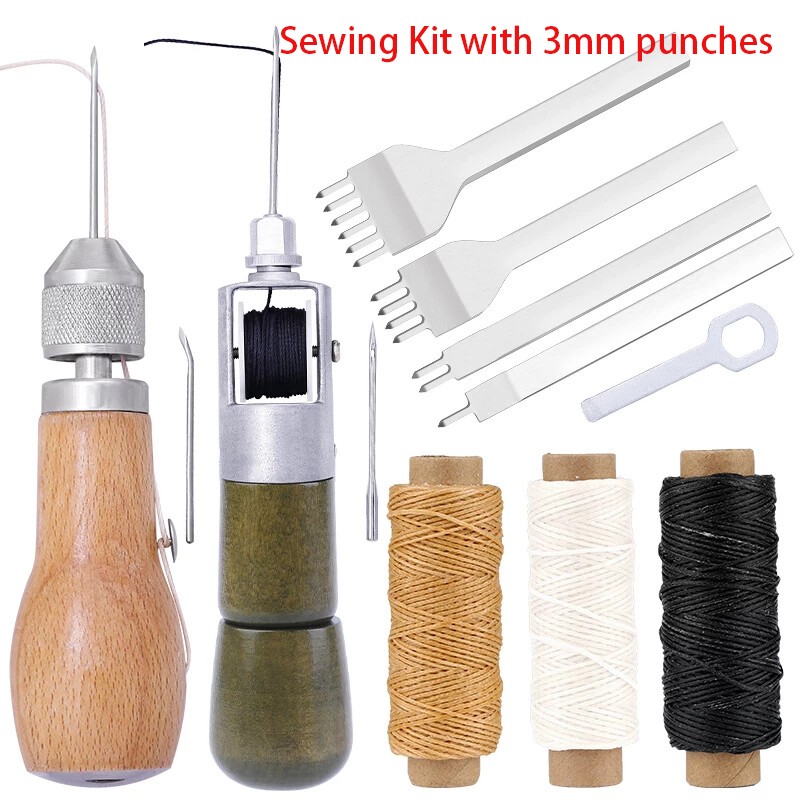

Photos from current listings. Actual item, color, and included accessories may vary.
Leather Stitching Awl Buying Guide
A leather stitching awl is a hand tool that punches through leather to create lock stitches, used for repair and small leathercraft projects. The core trade-off is between a fixed, single-purpose awl (stable, precise, but limited) and an interchangeable-head kit (versatile, but with looser tolerances and weaker locking mechanisms). Choose a fixed diamond or stitching awl with a hardened steel blade and a solid wood or knurled metal handle if you sew regularly; choose a multi-head speedy-stitch kit only for occasional repairs where one tool must cover multiple tasks.
Key takeaways
- Blade geometry matters more than handle style: diamond-profile awls slice and widen holes cleanly, while round-point awls tear fibers and are only for pre-punched holes.
- Hardened high-carbon or stainless steel blades hold an edge through thick veg-tan; soft mystery-steel blades roll and bend at the tip after a few dozen holes.
- Interchangeable-head 'speedy' awls lock via a collet or set screw; cheaper kits use friction-fit sockets that wobble and slip under pressure.
At a glance
- Category
- Leather Stitching Tools
- Last updated
- Nov 23, 2026
Current offers
Highlights
- Blade geometry matters more than handle style: diamond-profile awls slice and widen holes cleanly, while round-point awls tear fibers and are only for pre-punched holes.
- Hardened high-carbon or stainless steel blades hold an edge through thick veg-tan; soft mystery-steel blades roll and bend at the tip after a few dozen holes.
- Interchangeable-head 'speedy' awls lock via a collet or set screw; cheaper kits use friction-fit sockets that wobble and slip under pressure.
- Handle diameter and length determine control: 8-10 mm knurled metal or hardwood handles give grip for saddle stitching, while thin plastic handles cause hand fatigue on long seams.
Best use cases
- Best fit: repairing shoes, belts, or bags with waxed thread — pick a fixed diamond stitching awl plus a separate hole punch; skip multi-head kits whose coarse threads strip under repeated use.
- Best fit: small leathercraft projects (card holders, sheaths) — a single stabbing awl with a 2.5-3 mm diamond blade and hardwood handle gives the control needed for even stitch spacing.
- Wrong fit: production-volume sewing or thick saddle leather — hand awls are for low-volume work; move to a pricking iron and stitching pony rather than forcing a thin blade through dense leather.
- Wrong fit: crafting with soft garment leather or fabric — a sharp awl will stretch and tear thin material; use a fine needle or punch instead.
Buying tips
- Match blade width to thread: 2 mm blades suit 0.6-0.8 mm thread, 3 mm blades suit 1 mm thread; too-wide blades create oversized holes that weaken stitches.
- Check the locking mechanism: a collet or brass set screw with a flat on the blade shank is secure; plain friction-fit sockets are the main failure point in budget kits.
- Prefer blades with a forged taper and a polished finish — stamped flat blades with sharp edges cut the leather surface instead of parting it.
- Handle material beats handle shape: hardwood or knurled aluminum absorbs pressure better than hollow plastic, which cracks at the ferrule under repeated stabbing.
Specs
| Blade Profile | Diamond / Round / Flat |
|---|---|
| Blade Material | Hardened carbon or stainless steel |
| Handle Type | Fixed wood/metal vs interchangeable |
| Blade Width | 2-4 mm (thread-matched) |
Related searches
What to check before buying
- Measure your leather thickness: awls handle up to about 4-5 mm comfortably; thicker leather needs a punch or drill first.
- Confirm your thread size and desired stitch length so the blade width and hole spacing match your planned stitches per inch.
- Check that the handle fits your hand — a 90-100 mm handle length suits most adults; short handles reduce leverage on dense leather.
- If buying a kit, verify the heads are standard-diameter shanks (commonly 3-4 mm) so replacements are available separately.
FAQ
Data sources: eBay / Amazon listings and product attribute feeds. Updated Nov 23, 2026.
Some links on this page are affiliate links. If you buy after clicking one, we may earn a commission at no extra cost to you. This does not change which products appear here or their order. Affiliate disclosure.