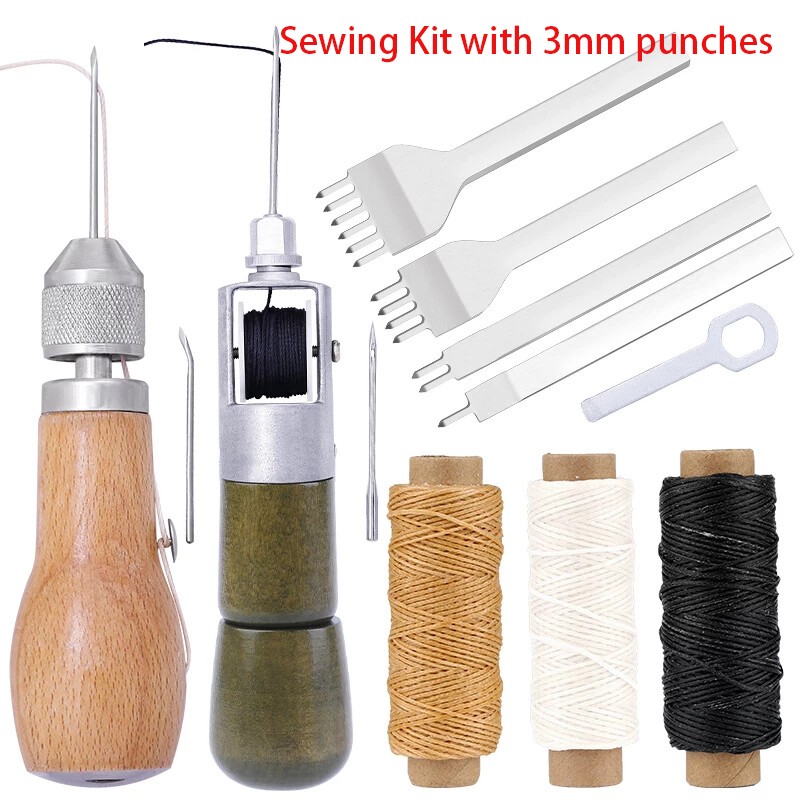

Photos from current listings. Actual item, color, and included accessories may vary.
Leather Stitching Punch Buying Guide
Leather stitching punches are the pricking irons and chisels that set stitch hole spacing, angle, and consistency—the foundation of clean hand-sewn leatherwork. The core trade-off is tooth geometry and hardness: French-style angled irons give slanted saddle stitches, while diamond/round-hole punches suit lacing and utility work, and hardened steel holds an edge through thousands of strikes where soft steel mushrooms. Buy hardened, correctly spaced irons matched to your thread and leather weight; skip unhardened multi-pack chisels with uneven teeth.
Median $59.99
Key takeaways
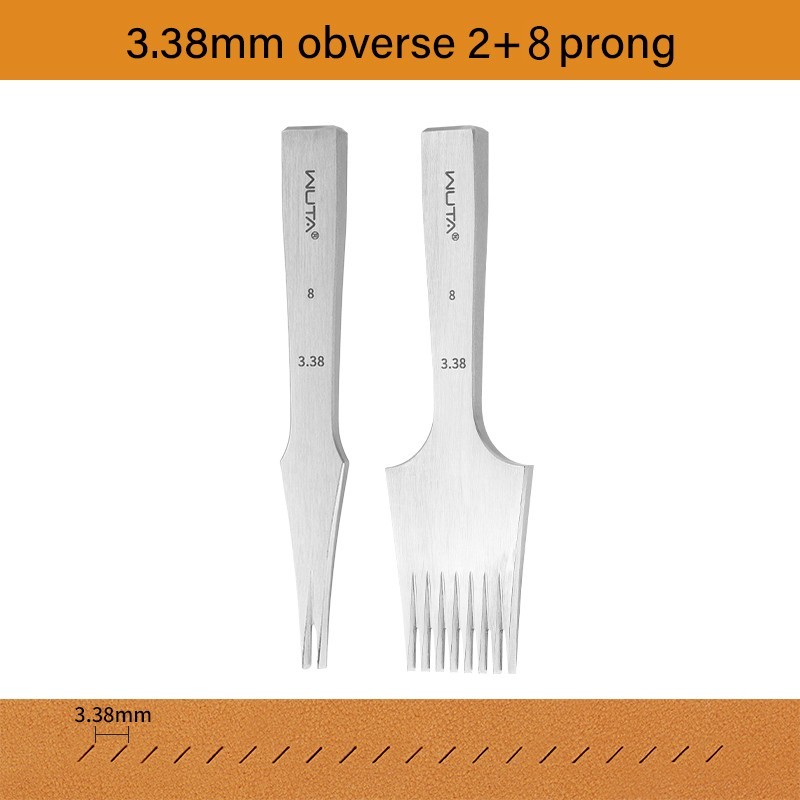
- French-style irons have angled flat teeth (typically 3–4 mm pitch) that produce slanted stitches; diamond chisels cut 4-sided holes for straight saddle stitching.
- Tooth pitch determines stitches per inch: ~3 mm = 8 SPI, ~4 mm = 6 SPI, ~5 mm = 5 SPI; match pitch to thread diameter and leather weight.
- Hardened tool steel (HRC 55–60 range) resists tooth bending and mushrooming; unhardened chisels dull and deform within a few hundred strikes.
At a glance
- Category
- Leather Stitching Tools
- Last updated
- Nov 23, 2026
Current offers
Highlights
- French-style irons have angled flat teeth (typically 3–4 mm pitch) that produce slanted stitches; diamond chisels cut 4-sided holes for straight saddle stitching.
- Tooth pitch determines stitches per inch: ~3 mm = 8 SPI, ~4 mm = 6 SPI, ~5 mm = 5 SPI; match pitch to thread diameter and leather weight.
- Hardened tool steel (HRC 55–60 range) resists tooth bending and mushrooming; unhardened chisels dull and deform within a few hundred strikes.
- Two-tooth, four-tooth, and six-tooth configurations trade corner control for speed: 2-prong for curves and corners, 6-prong for long straight runs.
Best use cases
- Best for wallets, card holders, and small goods: 2-prong and 4-prong French irons at 3–4 mm pitch with 0.45–0.6 mm waxed thread—skip 6-prong on curves and tight corners.
- Best for belts, straps, and long seams: 6-prong diamond or French chisels at 4–5 mm pitch speed up straight runs; skip 2-prong-only setups for long lines.
- Best for lacing, rivet layouts, and utility repairs: round-hole punches and awls; skip angled pricking irons where round lace or tube rivets must pass through.
- Wrong fit: soft-steel multi-packs under heavy mallet use—teeth bend and spacing drifts; upgrade to hardened irons before production work.
Buying tips
- Match pitch to thread: 3 mm pitch suits 0.45–0.6 mm thread; 4 mm suits 0.6–0.8 mm; 5 mm suits 0.8–1.0 mm and heavier leather.
- Choose tooth count by geometry: 2-prong for corners and curves, 4-prong general purpose, 6-prong for straight runs over ~150 mm.
- Confirm hardness and material—hardened tool steel or equivalent—because unhardened chisels mushroom at the striking end and dull quickly.
- Check tooth alignment and polish: uneven or burred teeth tear leather and drift stitch lines; polished flanks release cleanly from veg-tan.
Specs
| Punch Style | French pricking / Diamond chisel |
|---|---|
| Tooth Pitch | 3–5 mm (5–8 SPI) |
| Prong Count | 2, 4, or 6 teeth |
| Steel Hardness | Hardened tool steel, ~HRC 55–60 |
Related searches
What to check before buying
- Measure leather thickness: irons sized for 1–3 mm veg-tan differ from those for 4–6 mm bridle leather; thin leather needs finer pitch.
- Verify your stitching pony or clamp holds work at the angle your iron geometry expects—French irons are struck vertically, diamond chisels at 45°.
- Confirm mallet weight and striking surface: hardened irons need a non-metallic mallet; a poly or rawhide head protects the strike end.
- Check thread and needle sizing against hole geometry: round holes suit lacing and thick needles; angled slits suit saddle-stitch needles and waxed thread.
FAQ
Data sources: eBay / Amazon listings and product attribute feeds. Updated Nov 23, 2026.
Some links on this page are affiliate links. If you buy after clicking one, we may earn a commission at no extra cost to you. This does not change which products appear here or their order. Affiliate disclosure.