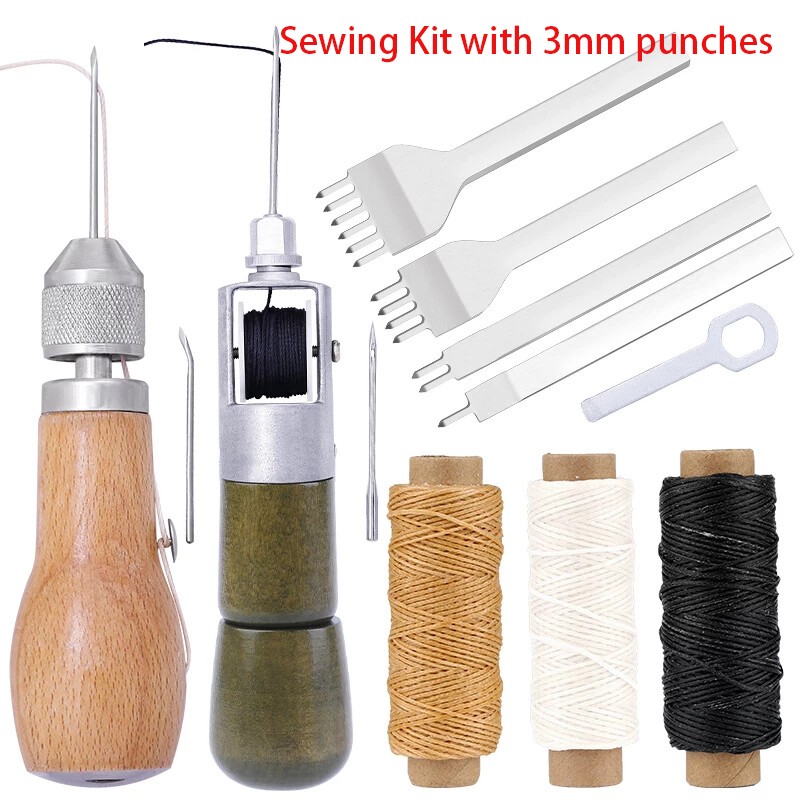

Photos from current listings. Actual item, color, and included accessories may vary.
Leather Stitching Punch Tool Buying Guide
A leather stitching punch tool is a pronged chisel that pierces evenly spaced holes in leather for hand-sewing, and the core trade-off is prong geometry and steel hardness versus price. Durable punches use hardened tool steel with polished, tapered prongs and a consistent stitch pitch, while cheap punches bend, burr, or drift off-line. The decision rule: buy a punch whose prong count, pitch, and steel grade match your leather weight and thread size, and skip any set that does not state its stitch spacing.
Median $59.99
Key takeaways
- French-style pricking irons use diamond-profile prongs for angled, slanted stitches; round-hole stitching chisels produce straight saddle stitches — the profile dictates the final stitch look.
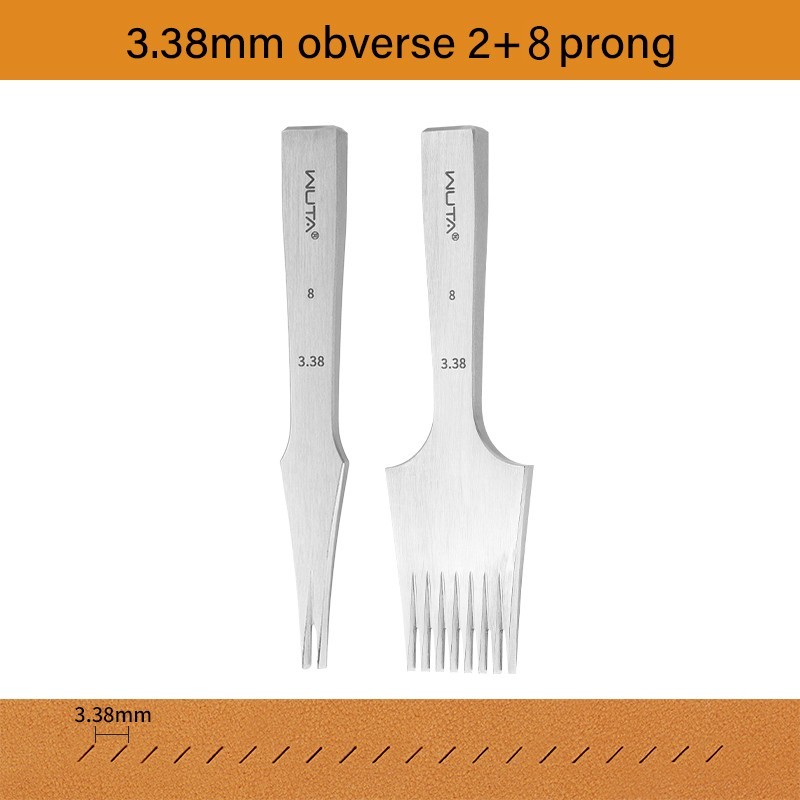
- Stitch pitch is measured in millimeters between prong tips (common: 2.7, 3.0, 3.38, 3.85, 4.0 mm); pitch must be smaller for thin leather and larger for thick leather or heavy thread.
- Prong count determines line length and control: 2-prong for curves and corners, 4-prong for straight runs, 6-prong for long edges — most buyers need a 2- and 4-prong pair first.
At a glance
- Category
- Leather Stitching Tools
- Last updated
- Nov 23, 2026
Current offers
Highlights
- French-style pricking irons use diamond-profile prongs for angled, slanted stitches; round-hole stitching chisels produce straight saddle stitches — the profile dictates the final stitch look.
- Stitch pitch is measured in millimeters between prong tips (common: 2.7, 3.0, 3.38, 3.85, 4.0 mm); pitch must be smaller for thin leather and larger for thick leather or heavy thread.
- Prong count determines line length and control: 2-prong for curves and corners, 4-prong for straight runs, 6-prong for long edges — most buyers need a 2- and 4-prong pair first.
- Hardened tool steel (HRC 55-60) with polished, tapered prongs resists bending and pulls cleanly; soft stainless or unhardened carbon steel burrs and mushrooms at the tip.
Best use cases
- Best fit: buy a 4-prong French-style pricking iron in 3.0-3.38 mm pitch if you sew wallets, card holders, and watch straps with 0.6 mm thread — skip 4 mm pitch, which leaves holes too large for fine thread.
- Best fit: choose a 2-prong plus 6-prong round-hole chisel set in 4.0 mm pitch for belts, holsters, and bags using 1.0 mm waxed thread — skip diamond irons if you want flat, straight saddle stitches.
- Wrong fit: avoid economy 6-piece punch kits with unbranded steel for production work — prongs bend and spacing drifts; buy individual hardened irons in the exact pitch you need instead.
Buying tips
- Match pitch to thread: 2.7-3.0 mm for 0.4-0.6 mm thread, 3.38-3.85 mm for 0.6-0.8 mm, and 4.0 mm+ for 1.0 mm thread; undersized holes fray thread and oversized holes look sloppy.
- Choose prong count by geometry: 2-prong for curves and corners, 4-prong for general straight stitching, 6-prong for long straight seams — buying only a 6-prong limits corner accuracy.
- Check steel hardness and finish: hardened tool steel at HRC 55-60 with polished, tapered prongs drives cleanly through 3-4 mm leather; soft steel requires wax and still burrs.
- Confirm the shank fits your handle or driver: most irons use a standard round or square shank, but some French-style sets require a dedicated collet or chuck — verify arbor size before mixing brands.
Specs
| Prong Profile | Diamond (French) vs Round |
|---|---|
| Stitch Pitch | 2.7 / 3.0 / 3.38 / 3.85 / 4.0 mm |
| Prong Count | 2 / 4 / 6 prong |
| Steel Hardness | Hardened tool steel HRC 55-60 |
Related searches
What to check before buying
- Measure your leather weight: under 2 mm needs 2.7-3.0 mm pitch, 2-4 mm needs 3.38-3.85 mm, and over 4 mm needs 4.0 mm or a pricking iron plus awl.
- Confirm your thread diameter and desired stitch look (slanted French vs straight saddle) before choosing diamond or round prongs.
- Check that the punch shank diameter matches your existing handle, driver, or collet — mismatched shanks require a new holder.
- Plan for a striking surface: use a polymer cutting board or poundo board, never glass or bare wood, to protect prong tips and keep holes clean.
FAQ
Data sources: eBay / Amazon listings and product attribute feeds. Updated Nov 23, 2026.
Some links on this page are affiliate links. If you buy after clicking one, we may earn a commission at no extra cost to you. This does not change which products appear here or their order. Affiliate disclosure.