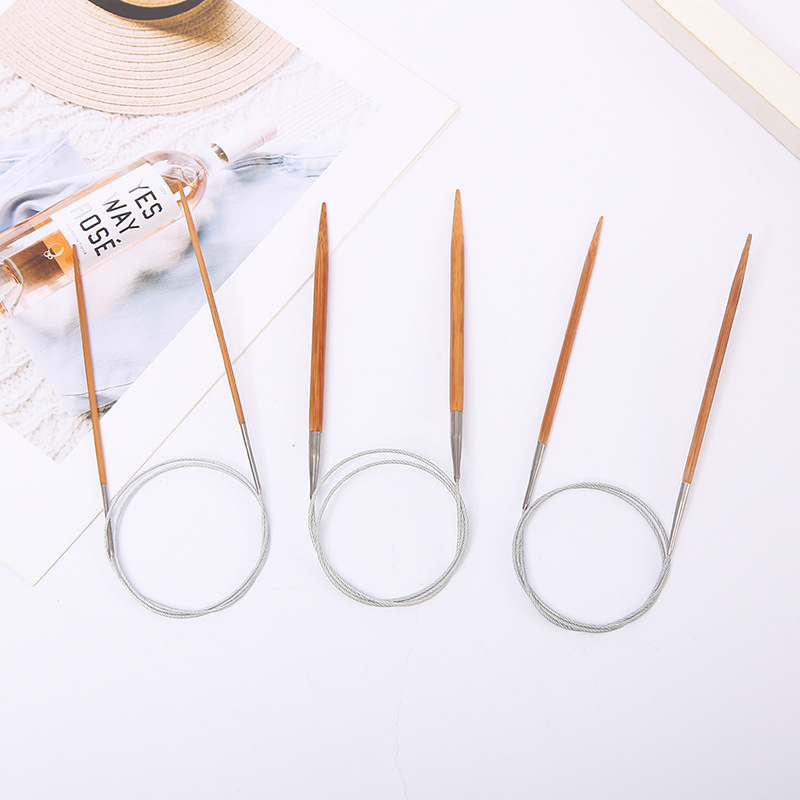

Photos from current listings. Actual item, color, and included accessories may vary.
Circular Knitting Needle Buying Guide
Circular knitting needles are two tapered tips joined by a flexible cord, letting you knit tubes (hats, socks, sleeves) and flat pieces beyond straight-needle capacity. The decisive trade-off is tip material versus cord quality: metal tips speed up slick yarns but can slide out of stitches, while wood/bamboo grips grippy fibers but drags; a kinked, thick cord ruins the glide regardless of tip. Buy needles with a smooth, swivel-jointed cord in a length shorter than your project's circumference, and skip fixed sets whose cord length or tip size won't match your gauge.
Key takeaways
- Cord-to-tip join defines quality: a smooth, snag-free swivel connection lets stitches slide; fixed needles with glued joins and memory-prone cords create drag and ladders.
- Tip material governs speed and grip: nickel-plated brass and stainless steel suit wool and smooth yarns; bamboo and birch suit slippery cotton, silk, and loose gauge.
- Interchangeable sets use screw or click-lock tips on swappable cords; verify the brand's join standard, because tips and cords are not cross-compatible between brands.
At a glance
- Category
- Knitting Needles & Accessories
- Last updated
- Nov 28, 2026
Current offers
Highlights
- Cord-to-tip join defines quality: a smooth, snag-free swivel connection lets stitches slide; fixed needles with glued joins and memory-prone cords create drag and ladders.
- Tip material governs speed and grip: nickel-plated brass and stainless steel suit wool and smooth yarns; bamboo and birch suit slippery cotton, silk, and loose gauge.
- Interchangeable sets use screw or click-lock tips on swappable cords; verify the brand's join standard, because tips and cords are not cross-compatible between brands.
- Needle length must be shorter than the project circumference: a 16-inch circular fits a hat, 32-40 inch cords suit sweaters and blankets, and 9-inch circulars are required for socks.
Best use cases
- Hats: choose a 16-inch circular in the needle size that matches your gauge, then switch to double-pointed needles or magic loop for the crown decreases.
- Socks and cuffs: use a 9-inch circular for small circumferences or a 32-40 inch cord for magic loop; skip 16-inch circulars, which are too long for sock tubes.
- Blankets and sweaters: pick a 32-40 inch cord so stitches spread without crowding; for large blankets, use interchangeable cords joined with a connector rather than straining a short fixed cord.
- Travel and gift knitting: a fixed circular in the single size you need is lighter and cheaper than a set, but skip fixed needles if you knit multiple gauges and sizes.
Buying tips
- Match cord length to circumference: for a hat measuring about 20 inches around, a 16-inch circular works; for a 40-inch sweater body, use a 32-40 inch cord.
- Choose tip material by yarn: stainless steel or nickel-plated brass for wool and smooth yarns, bamboo or birch for cotton, silk, and slippery synthetic blends.
- If buying interchangeable, standardize on one brand's join system (screw or click) and confirm tip sizes span your gauge range, typically US 2-15 (2.75-10 mm).
- Check the tip taper and point: sharp points help lace and k2tog decreases, while blunter tips suit bulky yarns and beginners prone to splitting stitches.
Specs
| Tip Material | Stainless steel / nickel brass / bamboo |
|---|---|
| Cord Length | 9-40 in (hat 16, sock 9, blanket 32-40) |
| Needle System | Fixed circular vs interchangeable set |
| Tip Size Range | US 0-15 (2.0-10 mm) |
Related searches
What to check before buying
- Measure your project circumference; the circular needle length must be shorter than that measurement so stitches slide freely.
- Confirm your gauge swatch needle size in the brand's sizing (US or metric) before committing to a fixed needle or a set's size range.
- For interchangeable sets, verify the join type (screw-in vs click-lock) and that replacement cords and connectors are available in the brand's system.
- Check cord material and memory: nylon-coated steel cords resist kinking; cheap plastic cords retain curls that fight your stitch flow.
FAQ
Data sources: eBay / Amazon listings and product attribute feeds. Updated Nov 28, 2026.
Some links on this page are affiliate links. If you buy after clicking one, we may earn a commission at no extra cost to you. This does not change which products appear here or their order. Affiliate disclosure.