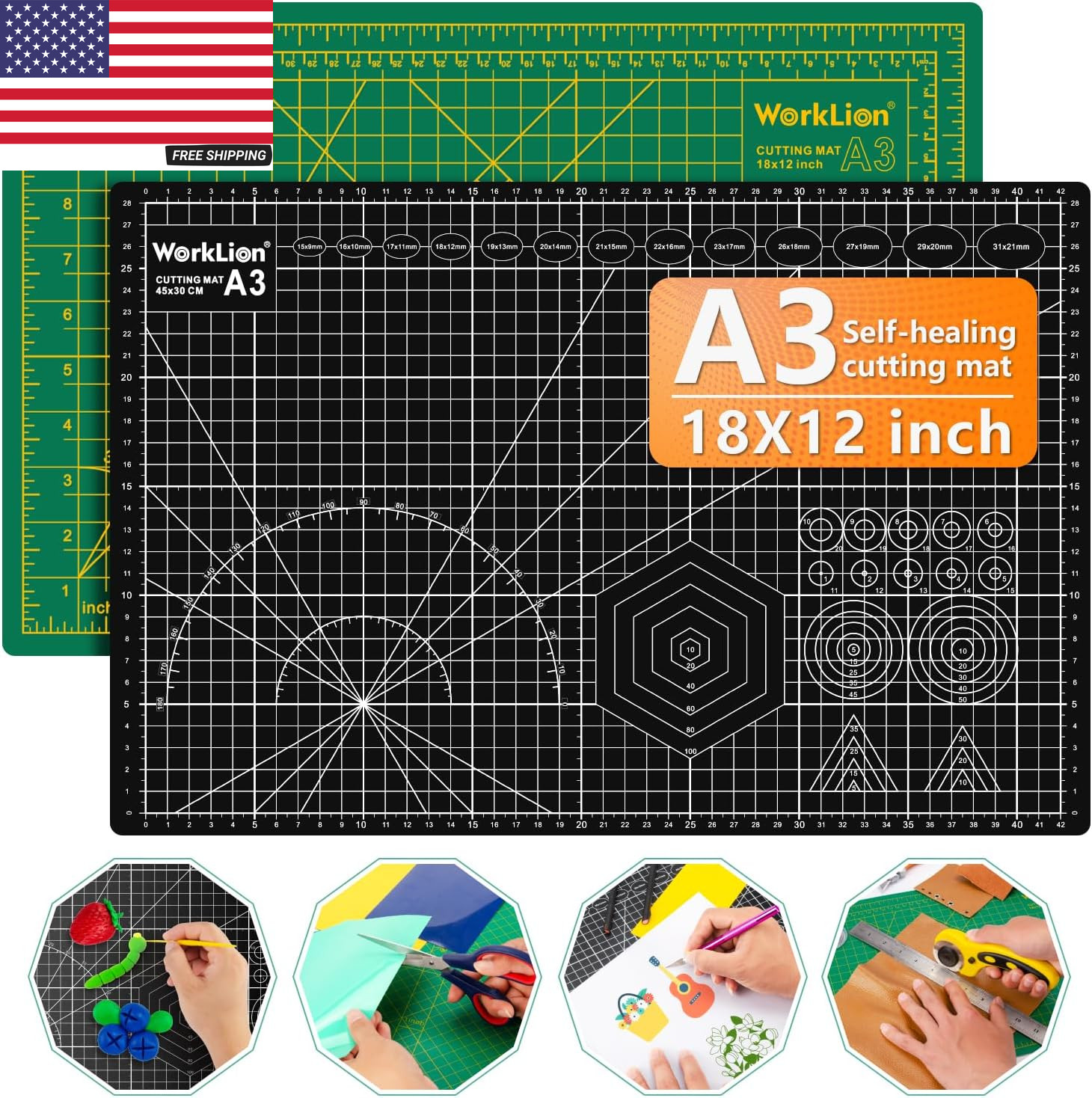

Photos from current listings. Actual item, color, and included accessories may vary.
Rotary Mat Buying Guide
A rotary mat is a self-healing polymer cutting surface engineered for rolling-blade trimmers, where the key trade-off is between soft, deep-scarring PVC that fails to recover and dense, multi-layer PVC that re-closes cuts for years. Buy a mat with at least three PVC layers plus a rigid core, and skip single-layer or 'no-name' sheets that groove and curl.
Layer Construction:3-layer to 5-layer self-healing PVCCommon Sizes:9x12, 12x18, 18x24, 24x36 inGrid Markings:1/8-in grid, 45/60-degree anglesMat Thickness:3mm (45mm cutters) to 5mm (60mm)
Typical price range$15.05
Key takeaways
- Layer count is the durability metric: 3-layer mats bond a soft top to a hard core, while 5-layer mats add impact-spreading skins that resist deep scoring.
- Double-sided mats give two working surfaces with pre-printed grids; the flip side is usually a contrasting color for visibility of light and dark fabrics.
- Standard grid scales are 1/8-inch with 1-inch major lines, plus 30/45/60-degree angle guides for bias strips and miter cuts.
At a glance
- Category
- Rotary Cutting Tools & Mats
- Last updated
- Nov 24, 2026
Current offers
Highlights
- Layer count is the durability metric: 3-layer mats bond a soft top to a hard core, while 5-layer mats add impact-spreading skins that resist deep scoring.
- Double-sided mats give two working surfaces with pre-printed grids; the flip side is usually a contrasting color for visibility of light and dark fabrics.
- Standard grid scales are 1/8-inch with 1-inch major lines, plus 30/45/60-degree angle guides for bias strips and miter cuts.
- PVC density, not thickness alone, drives self-healing: dense mats flex rather than chunk, and stay flat without curling at edges.
Best use cases
- Pick an 18x12-inch mat for rotary cutting of fat quarters, binding strips, and pattern pieces up to 12 inches wide; it fits most cutting tables and rolls up for storage.
- Choose a 9x12-inch mat for trimming small blocks, applique prep, and travel classes; skip it as a primary mat if you routinely cut yardage wider than 9 inches.
- Buy a large-format mat (24x36 or larger) only if you cut full-width yardage or quilt batting; smaller mats force re-positioning that introduces cutting error.
- Skip thin, single-layer promotional mats for daily sewing—they groove permanently under a 45mm rotary blade and lift at the edges within months.
Buying tips
- For rotary cutters up to 45mm, a 3mm (1/8-inch) mat is sufficient; step up to 4-5mm for 60mm cutters or heavy daily use.
- Match mat size to your most common cut: mat width should exceed fabric width by at least 2 inches to leave clamping and margin room.
- Choose a mat with inch and metric markings if you work from both pattern systems; dual-scale mats eliminate conversion errors.
- Prefer mats that state 'self-healing' with a layer count and PVC formulation; unlabeled mats are typically single-layer vinyl that scars.
Specs
| Layer Construction | 3-layer to 5-layer self-healing PVC |
|---|---|
| Common Sizes | 9x12, 12x18, 18x24, 24x36 in |
| Grid Markings | 1/8-in grid, 45/60-degree angles |
| Mat Thickness | 3mm (45mm cutters) to 5mm (60mm) |
Related searches
What to check before buying
- Measure your cutting table or desk; the mat must lie fully flat with no overhang, or cutting pressure will flex and crack it.
- Confirm your rotary cutter size (28mm, 45mm, or 60mm) so mat thickness matches blade pressure and stroke depth.
- Check storage: mats longer than 24 inches need flat storage or hanging; rolling a thick mat can leave a memory curl.
- Verify surface flatness on arrival—warped or bowed mats cannot be flattened reliably and should be returned immediately.
FAQ
Data sources: eBay / Amazon listings and product attribute feeds. Updated Nov 24, 2026.
Some links on this page are affiliate links. If you buy after clicking one, we may earn a commission at no extra cost to you. This does not change which products appear here or their order. Affiliate disclosure.