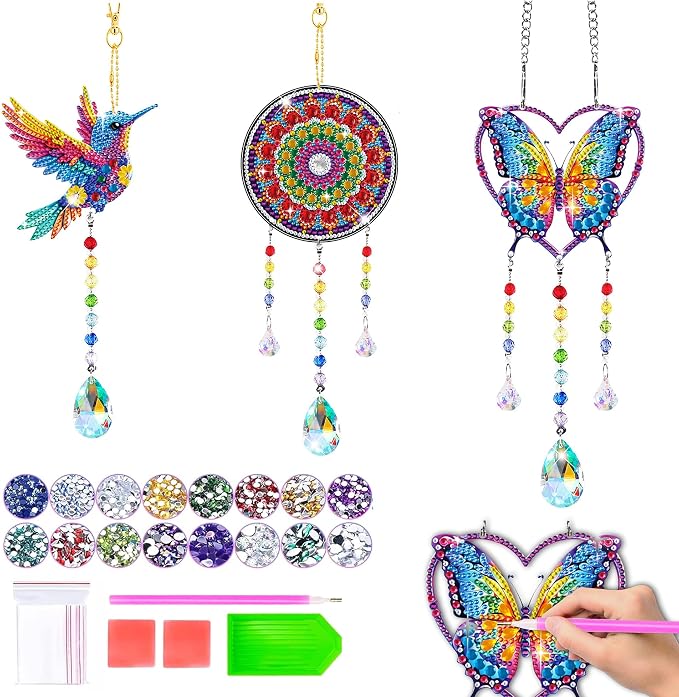

Photos from current listings. Actual item, color, and included accessories may vary.
Diamond Art Buying Guide
Diamond art is a paint-by-numbers craft where you place resin 'drills' onto a pre-printed adhesive canvas using a stylus and wax. The core trade-off is drill quality versus canvas adhesive: budget kits use acrylic drills with static-prone plastic and weak glue, while durable kits use resin drills with uniform faceting and a strong, long-tack adhesive. Buy resin drills on a poured-glue canvas with a printed legend that matches the drill bag labels; skip kits where drills are acrylic, the glue is a peel-off sheet, or the canvas is rolled too tightly for the drills to seat.
Key takeaways
- Drill material splits into two tiers: acrylic drills are cheaper, lighter, and prone to static and chipping; resin drills (often labeled 'epoxy resin' or 'resin rhinestones') hold facet sharpness and seat flatter for tighter gaps.
- Round drills dominate kids and beginner kits (5D round, ~2.8mm) for fast placement, while square drills (2.5–2.8mm) tile edge-to-edge with no gaps and are the standard for detailed adult canvases.
- Canvas adhesive quality is the hidden durability metric: poured-glue canvases keep tack for weeks of intermittent work, while peel-off glue sheets lose grip faster and lift drills in humid rooms.
At a glance
- Category
- Stamping, Embossing & Kids' Crafts
- Last updated
- Nov 28, 2026
Current offers
Highlights
- Drill material splits into two tiers: acrylic drills are cheaper, lighter, and prone to static and chipping; resin drills (often labeled 'epoxy resin' or 'resin rhinestones') hold facet sharpness and seat flatter for tighter gaps.
- Round drills dominate kids and beginner kits (5D round, ~2.8mm) for fast placement, while square drills (2.5–2.8mm) tile edge-to-edge with no gaps and are the standard for detailed adult canvases.
- Canvas adhesive quality is the hidden durability metric: poured-glue canvases keep tack for weeks of intermittent work, while peel-off glue sheets lose grip faster and lift drills in humid rooms.
- Full-drill kits cover every canvas square; partial-drill kits leave background printed and are faster but look less dimensional — full-drill multi-packs suit adults, partial-drill suits short kid sessions.
Best use cases
- Best fit for adults: a full-drill square-drill kit with a poured-glue canvas, a printed legend, and a spare-drill bag per color — pick this for framed wall art or gifts where gap-free coverage and long working sessions matter.
- Best fit for kids: a round-drill partial or small full-drill kit with a stiff board (not rolled canvas) and a chunky pen-style applicator — the 3D wind-chime/suncatcher format works because pieces are small and assemble without framing.
- Wrong fit: large-format canvases (over roughly 20x28 in) in square drill for first-timers — the session length and drill count overwhelm beginners; start on a 12x16 in round-drill canvas and size up after one completed piece.
- Wrong fit: peel-off adhesive sheets or acrylic drills for anything intended to hang in a humid room or bathroom — moisture lifts the glue and acrylic facets dull; choose poured glue and resin drills for humidity-exposed decor.
Buying tips
- Match drill shape to detail: square drills (2.5–2.8mm) for portraits and fine gradients because edges butt together; round drills (2.8mm) for kids and bold graphics where speed beats seamless coverage.
- Size the canvas to session math: a 12x16 in canvas at 2.8mm spacing runs roughly 30,000–35,000 drills, so reserve large formats (20x28 in and up) for multi-week projects or multi-person sessions.
- Demand a printed legend and numbered drill bags: a canvas symbol chart with a DMC-style color key lets you audit color counts before starting; unlabeled bags force guesswork mid-project.
- Choose a poured-glue canvas with a clear protective film and a stiff backing board for kids; rolled canvas curls and sends drills sliding, while board-backed kits stay flat on a table.
Specs
| Drill Shape | Round 2.8mm vs Square 2.5-2.8mm |
|---|---|
| Drill Material | Resin (epoxy) vs Acrylic |
| Canvas Adhesive | Poured glue vs Peel-off sheet |
| Coverage Type | Full-drill vs Partial-drill |
Related searches
What to check before buying
- Measure your intended frame or display space first: standard kits ship in 12x16, 16x20, and 20x28 in; a 20x28 in canvas needs roughly a 24x32 in frame with mat.
- Confirm the kit includes a stylus, wax or glue clay, and a drill tray — multi-placer tips (3, 6, 9 drill) speed large fills and are worth selecting explicitly.
- Check lighting and workspace: drills are tiny and colored; a daylight lamp and a shallow tray with raised edges prevent loss and eye strain during long sessions.
- For kids, verify age grading and small-part warnings: 2.8mm drills are a choke hazard under age 3, and kits for ages 6+ typically use larger drills and simpler legends.
FAQ
Data sources: eBay / Amazon listings and product attribute feeds. Updated Nov 28, 2026.
Some links on this page are affiliate links. If you buy after clicking one, we may earn a commission at no extra cost to you. This does not change which products appear here or their order. Affiliate disclosure.