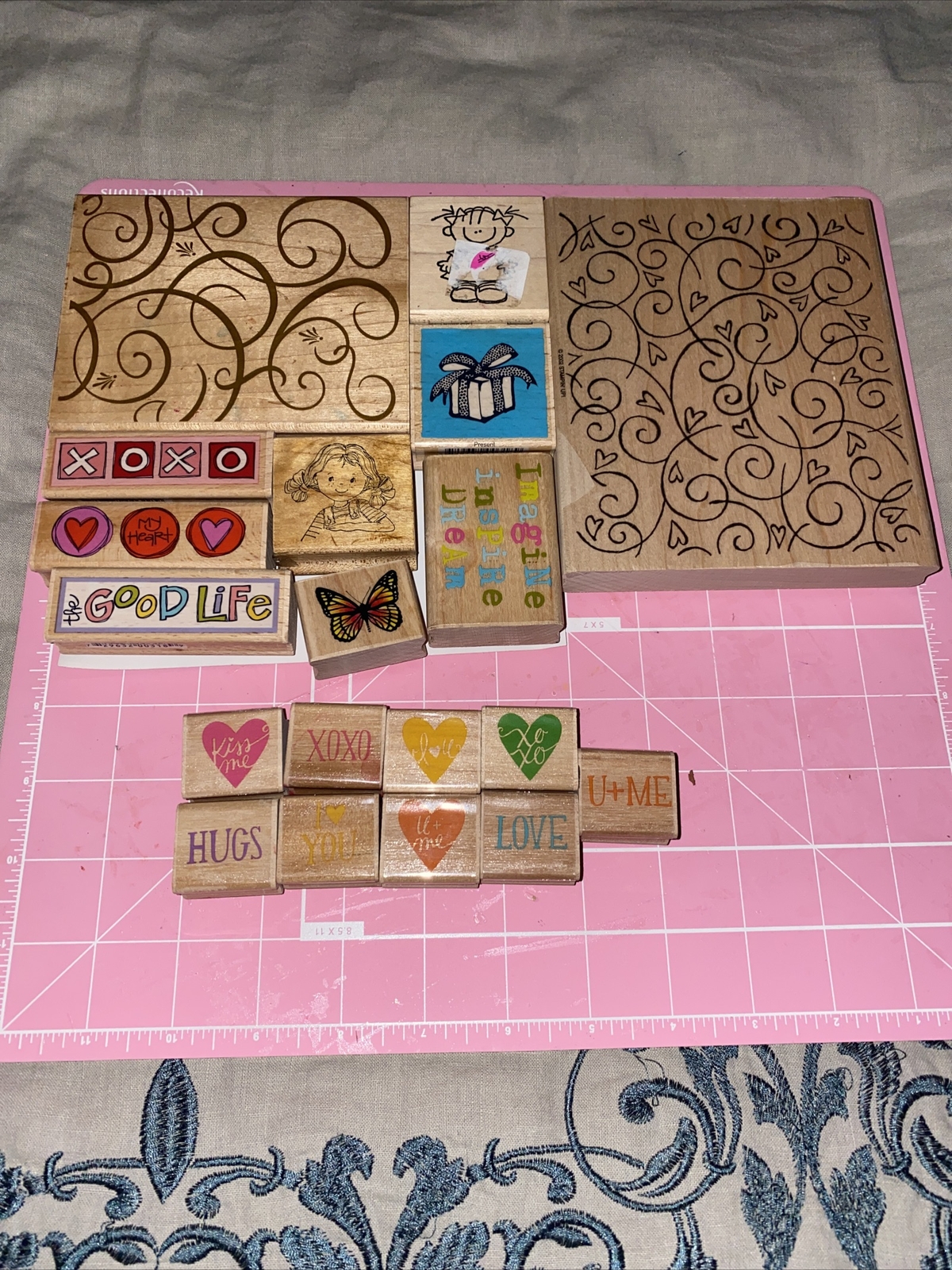

Photos from current listings. Actual item, color, and included accessories may vary.
Wood Stamp Buying Guide
Wood stamps are rubber impression tools permanently bonded to a shaped wooden block, offering superior pressure control and longevity versus clear polymer or foam alternatives. The primary trade-off is wood's rigid, non-repositionable mount versus clear stamps' see-through alignment, so the decision rule is: buy wood when you need deep, repeatable impressions for cardmaking, scrapbooking, or children's crafts; skip wood if you require precise multi-layer alignment on curved or textured surfaces.
Key takeaways
- Wood mount construction uses a 1–2 cm kiln-dried hardwood block with a vulcanized red or grey rubber die, giving even pressure distribution and no ink bleed under edges.
- Impression depth on wood stamps runs 2–3 mm, deeper than clear polymer's 1–1.5 mm, which improves coverage on porous paper and fabric but demands a flat, hard work surface.
- Index labels are printed directly on the block top, so alignment relies on a steady hand and acrylic blocks are not needed—unlike clear stamps.
At a glance
- Category
- Stamping, Embossing & Kids' Crafts
- Last updated
- Nov 28, 2026
Current offers
Highlights
- Wood mount construction uses a 1–2 cm kiln-dried hardwood block with a vulcanized red or grey rubber die, giving even pressure distribution and no ink bleed under edges.
- Impression depth on wood stamps runs 2–3 mm, deeper than clear polymer's 1–1.5 mm, which improves coverage on porous paper and fabric but demands a flat, hard work surface.
- Index labels are printed directly on the block top, so alignment relies on a steady hand and acrylic blocks are not needed—unlike clear stamps.
- Wood blocks are non-repositionable: the rubber is glued permanently, so each design is a fixed single-image tool, while clear stamp sets allow free composition of multiple images.
Best use cases
- Best fit for children's crafts and classroom stamping: wood blocks are easier for small hands to grip and resist bending, giving clean impressions on construction paper.
- Best fit for cardmaking and scrapbooking where a single iconic image (quotes, hearts, butterflies) is repeated across many projects—wood's durability outlasts thin clear stamps.
- Wrong fit for art journaling or mixed-media layering on bumpy watercolor paper: rigid wood cannot conform to texture and will miss low spots; choose foam or clear stamps instead.
- Wrong fit for travel or minimalist storage: wood blocks are bulky and heavy; a clear stamp set with one acrylic block is far more portable.
Buying tips
- Measure your intended surface: wood stamps need a flat area at least 1 cm larger than the block on all sides to apply even rocking pressure without edge lift.
- Choose kiln-dried hardwood (beech or maple) over soft pine: hardwood resists warping and moisture swelling that cause rubber edges to lift after repeated cleaning.
- Match rubber grade to ink: red vulcanized rubber suits water-based dye inks for paper; grey rubber takes pigment and solvent inks better for fabric and mixed media.
- For children under 5, pick blocks at least 2.5 cm thick and 4 cm wide—smaller wood blocks tip easily and produce smudged, partial impressions.
Specs
| Mount Type | Kiln-dried hardwood block, 1–2 cm thick |
|---|---|
| Rubber Grade | Red vulcanized or grey rubber, 2–3 mm relief |
| Impression Depth | 2–3 mm (deeper than clear polymer) |
| Ink Compatibility | Dye, pigment, solvent; avoid alcohol inks |
Related searches
What to check before buying
- Confirm your work surface is hard, flat, and non-porous; wood stamps will not give clean impressions on soft mats, fabric piles, or curved objects.
- Check storage space: a 20-piece wood stamp lot occupies roughly a shoebox; plan for a divided wood or acrylic rack to prevent rubber scuffing.
- Verify ink compatibility before first use: water-based dye inks dry fast on paper, but pigment inks need heat setting on fabric and may stain red rubber permanently.
- For kids' use, ensure ink pads are washable and non-toxic (ASTM D-4236 or ACMI AP seal), since wood blocks are harder to rinse clean than clear stamps.
FAQ
Data sources: eBay / Amazon listings and product attribute feeds. Updated Nov 28, 2026.
Some links on this page are affiliate links. If you buy after clicking one, we may earn a commission at no extra cost to you. This does not change which products appear here or their order. Affiliate disclosure.