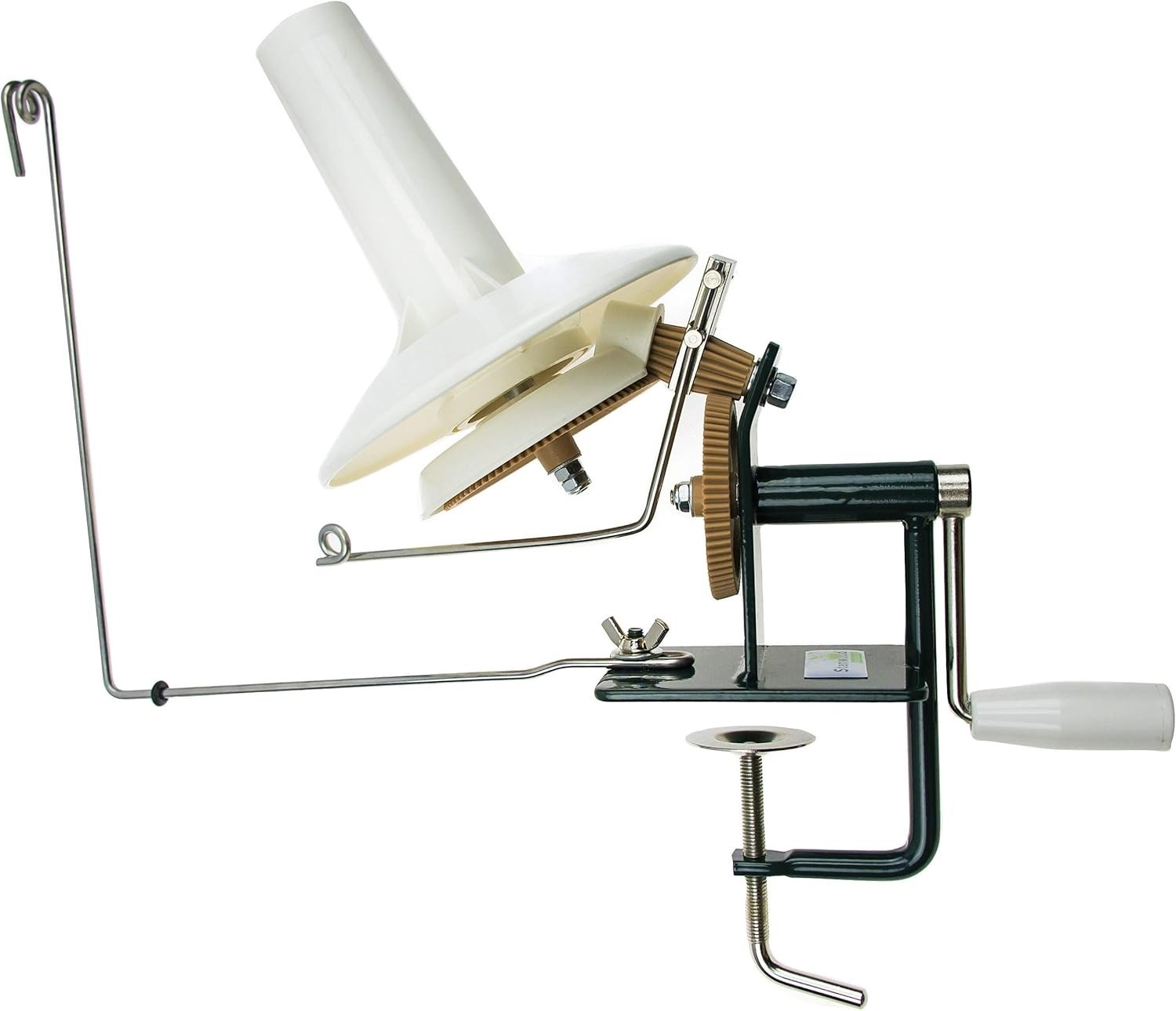

Photos from current listings. Actual item, color, and included accessories may vary.
Stanwood Needlecraft Yarn Winder Buying Guide
The Stanwood Needlecraft Yarn Winder is a metal-geared hand-crank ball winder that converts skeins and hanks into center-pull cakes for tension-controlled knitting and crochet. The core trade-off is metal vs. plastic gearing and 10 oz vs. 4 oz capacity: metal gears and a 10 oz winding head last for high-volume use, while 4 oz plastic models suit light, occasional winding. Buy the Large Metal 10 oz for durability and full-skein capacity; skip toy-grade plastic winders if you wind more than a few skeins per month.
Key takeaways
- Metal gear train (steel/brass) versus nylon or plastic gears: metal teeth resist stripping under worsted-weight tension and repeated cranking.
- 10 oz cake capacity handles a full 100 g skein plus most 50 g double strands; 4 oz models require splitting skeins before winding.
- Clamp-on table mount with foam pad grips surfaces up to roughly 2 inches thick; no permanent drilling or bolting required.
At a glance
- Category
- Yarn Winders & Project Bags
- Last updated
- Nov 28, 2026
Current offers
Highlights
- Metal gear train (steel/brass) versus nylon or plastic gears: metal teeth resist stripping under worsted-weight tension and repeated cranking.
- 10 oz cake capacity handles a full 100 g skein plus most 50 g double strands; 4 oz models require splitting skeins before winding.
- Clamp-on table mount with foam pad grips surfaces up to roughly 2 inches thick; no permanent drilling or bolting required.
- Hand-crank operation needs no power outlet and gives direct tension feedback, unlike motorized winders that can over-tension delicate singles.
Best use cases
- Best fit: knitters who buy full 100 g skeins and wind weekly—choose the Large Metal 10 oz for metal gears and one-pass skein capacity.
- Wrong fit: someone winding one or two balls a year—a 4 oz plastic winder or hand-winding is cheaper and adequate at that volume.
- Best fit: crocheters working from center-pull cakes to avoid tangling—the 10 oz cake fits standard hook projects and stacks flat in project bags.
- Wrong fit: production dyers winding hundreds of skeins—step up to a motorized or larger-capacity winder; the hand crank becomes a bottleneck.
Buying tips
- Match capacity to skein weight: a 10 oz (approx. 283 g) head winds a 100 g skein in one pass; 4 oz heads force you to split standard skeins.
- Choose metal gears over plastic if you wind more than a few skeins a month—stripped nylon gears are the most common failure point.
- Confirm the clamp opens wide enough for your table: most winders grip up to about 2 inches, so thick butcher-block tables need a spacer.
- Check the winding ratio: higher gear ratios (roughly 10:1 or more) wind faster per crank, which matters when processing multiple skeins.
Specs
| Winder Type | Hand-crank ball winder |
|---|---|
| Cake Capacity | 4 oz vs 10 oz (113 g vs 283 g) |
| Gear Material | Metal vs plastic/nylon |
| Mount Style | C-clamp table edge, up to ~2 in |
Related searches
What to check before buying
- Measure your table or shelf edge thickness—the clamp must open to at least that width, typically up to 2 inches.
- Clear a flat, stable surface near your yarn: the winder needs a vertical crank path and room for the cake to grow to 4–5 inches wide.
- Confirm you have a yarn swift or a helper to hold the skein; a winder alone cannot tension an unheld hank.
- Check that your yarn weight suits the winder: bulky and super-bulky yarns reach capacity faster and may need splitting even on 10 oz models.
FAQ
Data sources: eBay / Amazon listings and product attribute feeds. Updated Nov 28, 2026.
Some links on this page are affiliate links. If you buy after clicking one, we may earn a commission at no extra cost to you. This does not change which products appear here or their order. Affiliate disclosure.