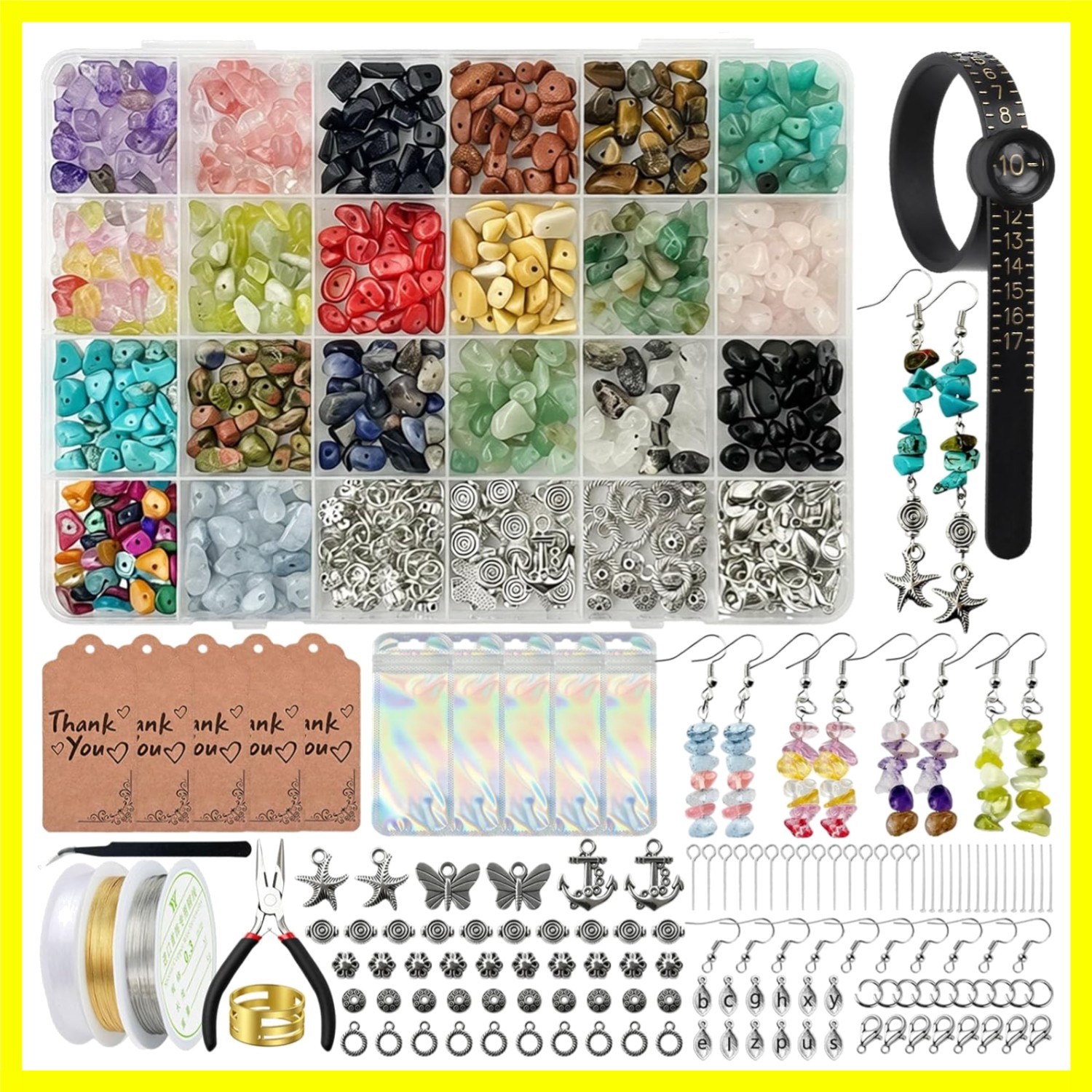

Photos from current listings. Actual item, color, and included accessories may vary.
Jewellery Making Kit Buying Guide
A jewellery making kit bundles matched beads, findings, stringing materials, and tools into a single start-ready set; the core trade-off is bead material and coating quality versus component count and box volume. Durable kits specify stone or glass composition, metal finding grade (stainless or plated brass), and cord tensile strength, while compromise kits inflate piece counts with acrylic filler and thin-plated findings that tarnish. The decision rule: buy by material grade and finding metallurgy first, then let piece count break ties only within the same material class.
Key takeaways
- Natural stone beads (agate, jasper, quartz) hold colour and polish permanently; dyed or coated stone and acrylic beads fade or flake with wear and cleaning.
- Findings in 304/316 stainless steel resist tarnish and skin reaction; silver-plated or brass-based findings darken within weeks on open display.
- Stretch cord performance is set by diameter and braid: 0.7–0.8 mm multi-strand elastic suits 6–8 mm beads, while 0.5 mm snaps under daily wear.
At a glance
- Category
- Beads & Jewelry Making
- Last updated
- Nov 28, 2026
Current offers
Highlights
- Natural stone beads (agate, jasper, quartz) hold colour and polish permanently; dyed or coated stone and acrylic beads fade or flake with wear and cleaning.
- Findings in 304/316 stainless steel resist tarnish and skin reaction; silver-plated or brass-based findings darken within weeks on open display.
- Stretch cord performance is set by diameter and braid: 0.7–0.8 mm multi-strand elastic suits 6–8 mm beads, while 0.5 mm snaps under daily wear.
- Kit piece counts are usually dominated by seed or spacer beads; the bead sizes that actually drive design options are the 6 mm, 8 mm, and 10 mm rounds.
Best use cases
- Best fit: adults starting bracelet and necklace making — choose a kit with 6/8/10 mm rounds, 0.7 mm elastic, and stainless findings; skip kits whose count is mostly 2 mm seed beads.
- Best fit: gift or shared craft session — pick a compartmented box kit with two or more pliers and beading needles; skip single-tool pouches that force duplicate purchases.
- Best fit: gemstone-focused makers — choose natural stone assortments with named species (agate, jasper, quartz); skip 'crystal' kits that are acrylic or glass with no stone content.
- Wrong fit: wire-wrapping and metalwork — general bead kits include nylon-jaw pliers and light wire only; buy a dedicated wirework set with hardened cutters and dead-soft wire.
Buying tips
- Match bead hole to cord: 6–8 mm beads usually have 0.8–1.2 mm holes, so 0.7–0.8 mm elastic or 0.4–0.5 mm beading wire threads cleanly without doubling.
- Check finding grade in the listing text: 'stainless steel' or '304/316' lasts; 'silver-plated', 'gold-plated', and 'alloy' are cosmetic and tarnish with sweat and humidity.
- Prefer kits stating bead sizes in millimetres (6, 8, 10 mm) over vague 'mixed sizes' — hole diameter and bead diameter determine which designs are possible.
- For gemstone content, require named species and treatment status; 'natural stone' plus a species name signals real mineral, while 'fashion stone' and 'crystal' often mean glass or acrylic.
Specs
| Bead Material | Natural stone vs glass vs acrylic |
|---|---|
| Finding Grade | Stainless 304/316 vs plated alloy |
| Bead Size Range | 6 / 8 / 10 mm rounds |
| Cord & Wire | 0.7–0.8 mm elastic, 0.4–0.5 mm wire |
Related searches
What to check before buying
- Measure wrist or neck size before choosing bead diameter: a 7-inch bracelet in 8 mm rounds needs roughly 22 beads, in 10 mm roughly 18 — confirm the kit's per-size counts cover a full piece.
- Confirm storage: a compartmented box with dividers keeps 6/8/10 mm sizes separated; loose bags force sorting before every session.
- Check tool inclusion: round-nose and chain-nose pliers plus a side cutter cover most bead-stringing repairs; nylon-jaw pliers are needed only for wirework.
- Verify cord and wire quantities in metres or spools, not 'enough for several projects' — 0.7 mm elastic at 0.5 m per bracelet means a 5 m spool yields about ten restrings.
FAQ
Data sources: eBay / Amazon listings and product attribute feeds. Updated Nov 28, 2026.
Some links on this page are affiliate links. If you buy after clicking one, we may earn a commission at no extra cost to you. This does not change which products appear here or their order. Affiliate disclosure.