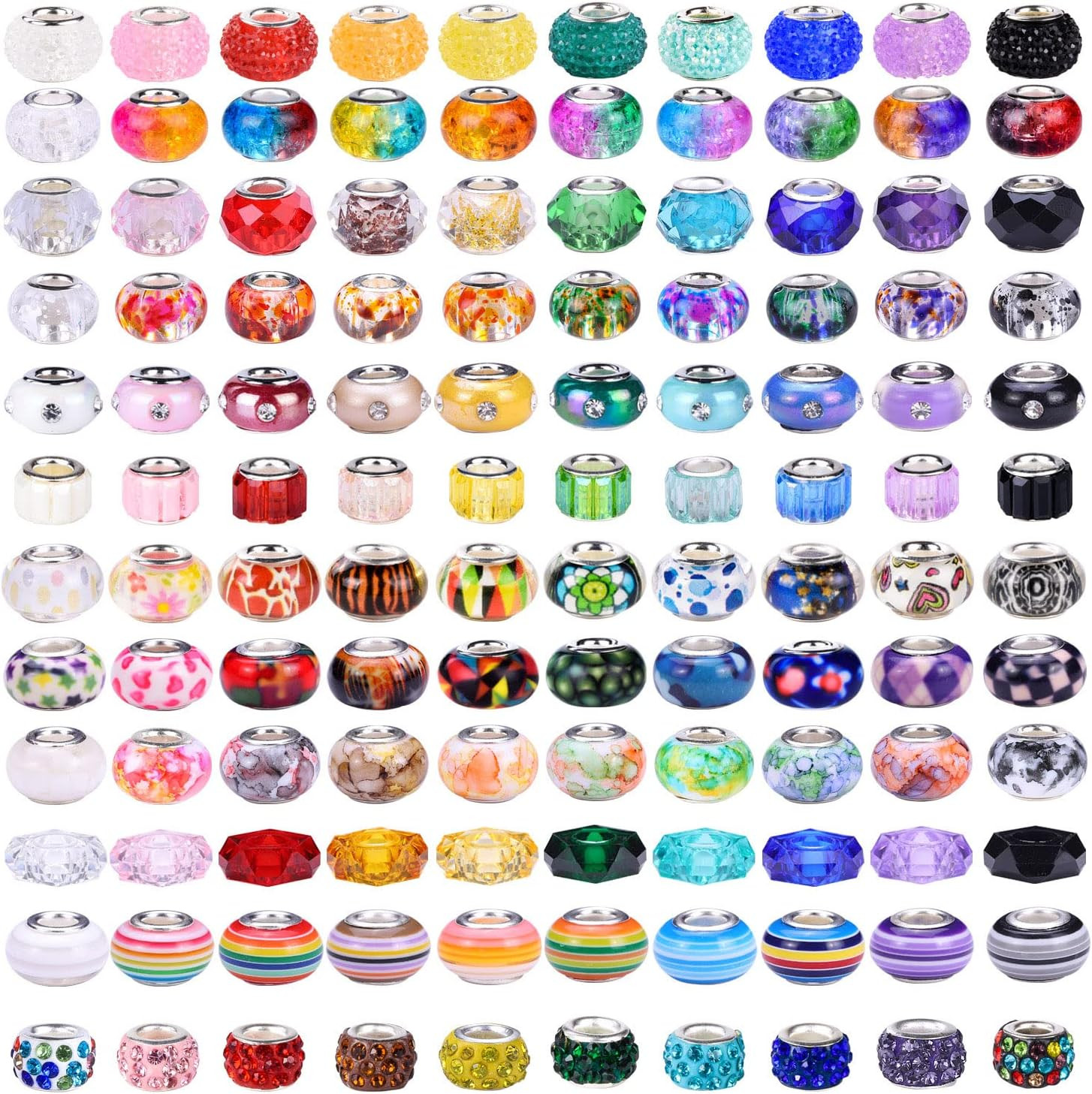

Photos from current listings. Actual item, color, and included accessories may vary.
Large Hole Spacer Bead Buying Guide
Large-hole spacer beads are decorative or structural beads with bore diameters typically 3–8 mm, designed to slide over thicker stringing materials like leather cord, memory wire, or multiple-strand bundles. The core trade-off is bore consistency versus material durability: lampwork glass and acrylic offer color variety but can chip at the hole edge, while metal and ceramic spacers hold tolerance and resist wear under tension. Choose based on cord diameter and abrasion exposure—match bore to cord with 0.5–1 mm clearance, and upgrade to metal or kiln-annealed glass for high-friction or load-bearing designs.
Key takeaways
- Lampwork glass beads are wound on mandrels; bore diameter is set by mandrel gauge, commonly 2.5–3.2 mm for standard spacers, while 'large hole' lampwork typically runs 4–6 mm and must be kiln-annealed to survive cord tension.
- Acrylic large-hole beads are injection-molded; hole edges often carry flash or sharp parting lines that abrade leather and elastic cord—deburring or choosing tumbled glass/metal avoids cord fray.
- Metal spacer beads (sterling, brass, stainless) hold bore tolerance within ±0.1–0.2 mm and are the only option for load-bearing or high-friction applications like bracelets on memory wire.
At a glance
- Category
- Beads & Jewelry Making
- Last updated
- Nov 28, 2026
Current offers
Highlights
- Lampwork glass beads are wound on mandrels; bore diameter is set by mandrel gauge, commonly 2.5–3.2 mm for standard spacers, while 'large hole' lampwork typically runs 4–6 mm and must be kiln-annealed to survive cord tension.
- Acrylic large-hole beads are injection-molded; hole edges often carry flash or sharp parting lines that abrade leather and elastic cord—deburring or choosing tumbled glass/metal avoids cord fray.
- Metal spacer beads (sterling, brass, stainless) hold bore tolerance within ±0.1–0.2 mm and are the only option for load-bearing or high-friction applications like bracelets on memory wire.
- European-style large-hole beads (commonly 4.5–5.5 mm bore) are sized for 3 mm leather or 2 mm round leather cord and are not interchangeable with Pandora-style 4.5 mm snake-chain systems without a compatible core.
Best use cases
- Leather wrap bracelets on 1.5–2 mm round leather cord: pick 3–4 mm bore glass or metal spacers; skip 2 mm-bore seed beads and any bead with visible mold flash.
- Memory-wire bangles: use metal spacers with 4–5 mm bore and rounded hole edges; avoid acrylic and unannealed lampwork, which crack under repeated flex.
- Multi-strand necklaces bundling 3–5 strands of 0.5 mm cord: choose 5–6 mm bore ceramic or metal spacers that consolidate strands without pinching; skip single-strand 2 mm spacers.
- Kids' or quick-gift crafts on 3 mm elastic: acrylic large-hole beads work if hole edges are smooth; for anything worn daily, step up to tumbled glass or metal to prevent cord cutting.
Buying tips
- Measure your cord or wire first: bore should exceed cord diameter by 0.5–1 mm. A 2 mm leather cord needs a 3 mm minimum bore; 3 mm cord needs 4 mm or larger.
- For load-bearing or daily-wear pieces, specify metal (stainless, brass, sterling) spacers—acrylic and unannealed glass deform or crack at the hole under sustained tension.
- Lampwork glass spacers must be kiln-annealed; unannealed 'craft' glass beads are prone to thermal shock cracks radiating from the bore.
- Check hole-edge finish: tumbled or fire-polished edges protect cord; sharp mold lines on acrylic or seam ridges on cast metal will fray leather and cut elastic over time.
Specs
| Bore Diameter | 3–6 mm (large-hole range) |
|---|---|
| Material Grade | Annealed glass / acrylic / metal |
| Hole Edge Finish | Tumbled / chamfered vs mold-flash |
| Cord Compatibility | Leather 1.5–3 mm / memory wire |
Related searches
What to check before buying
- Confirm cord/stringing diameter with calipers before ordering—bore sizing is nominal and ±0.3 mm variance is common in glass and acrylic.
- Verify bead outer diameter clears your design: a 10 mm outer bead on a 6 mm bore leaves only 2 mm wall, which is fragile in glass.
- For leather or suede, check that the bore is smooth and chamfered; rough interiors abrade cord at the exit point under tension.
- Match bead material to clasp and findings metal to avoid galvanic discoloration—brass spacers with sterling findings will tarnish the contact points.
FAQ
Data sources: eBay / Amazon listings and product attribute feeds. Updated Nov 28, 2026.
Some links on this page are affiliate links. If you buy after clicking one, we may earn a commission at no extra cost to you. This does not change which products appear here or their order. Affiliate disclosure.