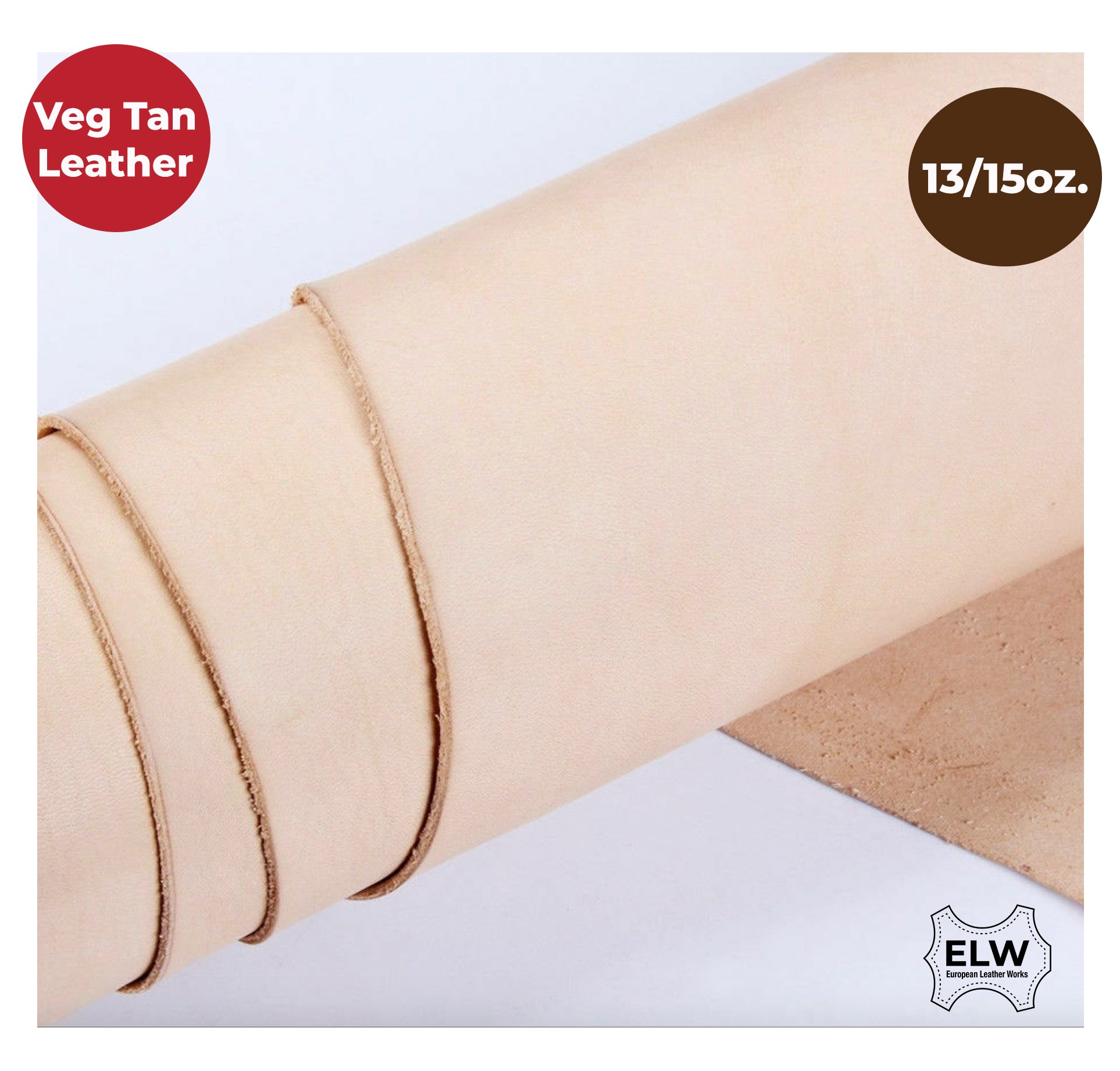

Photos from current listings. Actual item, color, and included accessories may vary.
3 Veg Tan Leather Buying Guide
Vegetable-tanned leather is a full-grain hide tanned with plant tannins (typically mimosa, quebracho, or chestnut), prized for its firm hand, tooling response, and patina—unlike chrome-tanned leather, which is softer, more uniform, and faster to produce. The core trade-off is temper and ounce weight: thinner, softer veg tan (2–3 oz) drapes and folds, while thicker, firmer veg tan (5–8 oz) holds shape and takes carving. Buy full-grain, tannery-named hides in the ounce range matched to your build, and skip bonded or split leather sold as 'veg tan'—it will delaminate or crack.
Key takeaways
- Vegetable tanning uses plant tannins over weeks, leaving a dense, firm fiber structure that burnishes and darkens with UV and handling; chrome tan uses chromium salts in hours and stays soft and colorfast.
- Ounce weight equals thickness in 1/64 in: 3–4 oz is ~1.2–1.6 mm (wallets, small bags), 5–6 oz is ~2.0–2.4 mm (belts, straps), 8–10 oz is ~3.2–4.0 mm (holsters, heavy cases).
- Full-grain vs top-grain vs split: full-grain retains the tight outer grain for maximum tensile strength and tooling crispness; split or bonded leather lacks that grain and fails at folds.
At a glance
- Category
- Leather Hides & Panels
- Last updated
- Nov 28, 2026
Current offers
Highlights
- Vegetable tanning uses plant tannins over weeks, leaving a dense, firm fiber structure that burnishes and darkens with UV and handling; chrome tan uses chromium salts in hours and stays soft and colorfast.
- Ounce weight equals thickness in 1/64 in: 3–4 oz is ~1.2–1.6 mm (wallets, small bags), 5–6 oz is ~2.0–2.4 mm (belts, straps), 8–10 oz is ~3.2–4.0 mm (holsters, heavy cases).
- Full-grain vs top-grain vs split: full-grain retains the tight outer grain for maximum tensile strength and tooling crispness; split or bonded leather lacks that grain and fails at folds.
- Tannery-grade veg tan (e.g., Hermann Oak, Wickett & Craig, Horween) is sold by square foot or side with consistent temper; craft-store 'veg tan' sheets are often 2–3 oz belly or shoulder with variable density.
Best use cases
- Best fit: 3–4 oz full-grain veg tan shoulder for wallets, card holders, and small pouches—thin enough to skive and fold cleanly without a splitter.
- Best fit: 5–6 oz veg tan bend or back for belts, dog collars, and bag straps—firm enough to resist stretch under load, yet carvable with a swivel knife.
- Best fit: 8–10 oz veg tan for holsters, knife sheaths, and hard cases—thick enough to wet-form and hold molded detail without reinforcement.
- Wrong fit: 2–3 oz veg tan for a load-bearing belt or strap—too thin and will stretch; wrong fit: 8–10 oz for a lined wallet—too bulky to fold and edge-paint cleanly.
Buying tips
- Convert ounce to millimeters with 1 oz = 0.4 mm: choose 1.2–1.6 mm (3–4 oz) for folds, 2.0–2.4 mm (5–6 oz) for straps, 3.2–4.0 mm (8–10 oz) for molded goods.
- Buy by square foot for small projects (a 12x12 in panel = 1 sq ft) or by side for volume; a full side averages 18–24 sq ft, a shoulder 4–8 sq ft.
- Specify 'full-grain, vegetable-tanned, tannery name' and reject 'genuine leather' or 'bonded leather' labels—those are split or reconstituted and will crack at stress points.
- Temper matters as much as weight: 'firm' veg tan carves and holds shape; 'soft' or 'milled' veg tan drapes but resists tooling—match temper to the finished form.
Specs
| Tannage | Vegetable (plant tannin) vs Chrome |
|---|---|
| Grain Grade | Full-grain > Top-grain > Split |
| Weight Range | 2–3 oz to 10–12 oz (0.8–4.8 mm) |
| Temper | Firm/tooling vs Soft/milled |
Related searches
What to check before buying
- Measure your pattern's largest flat piece in square inches and add 20% waste: this determines whether a 12x12 in panel, a shoulder, or a full side is the minimum purchase.
- Confirm your tools handle the weight: a 3–4 oz project needs only a rotary punch and edge beveler; 8–10 oz requires a heavy maul, stitching pony, and stitching chisels rated for thick leather.
- Check finish compatibility: veg tan accepts water-based dyes, antique paste, and burnishing gums; chrome-tanned leather rejects water-based finishes and needs solvent-based products.
- For wet-forming (holsters, sheaths), buy 'tooling' or 'carving' grade veg tan, not 'upholstery' or 'garment' grade—the latter is softened and will not hold molded detail.
FAQ
Data sources: eBay / Amazon listings and product attribute feeds. Updated Nov 28, 2026.
Some links on this page are affiliate links. If you buy after clicking one, we may earn a commission at no extra cost to you. This does not change which products appear here or their order. Affiliate disclosure.