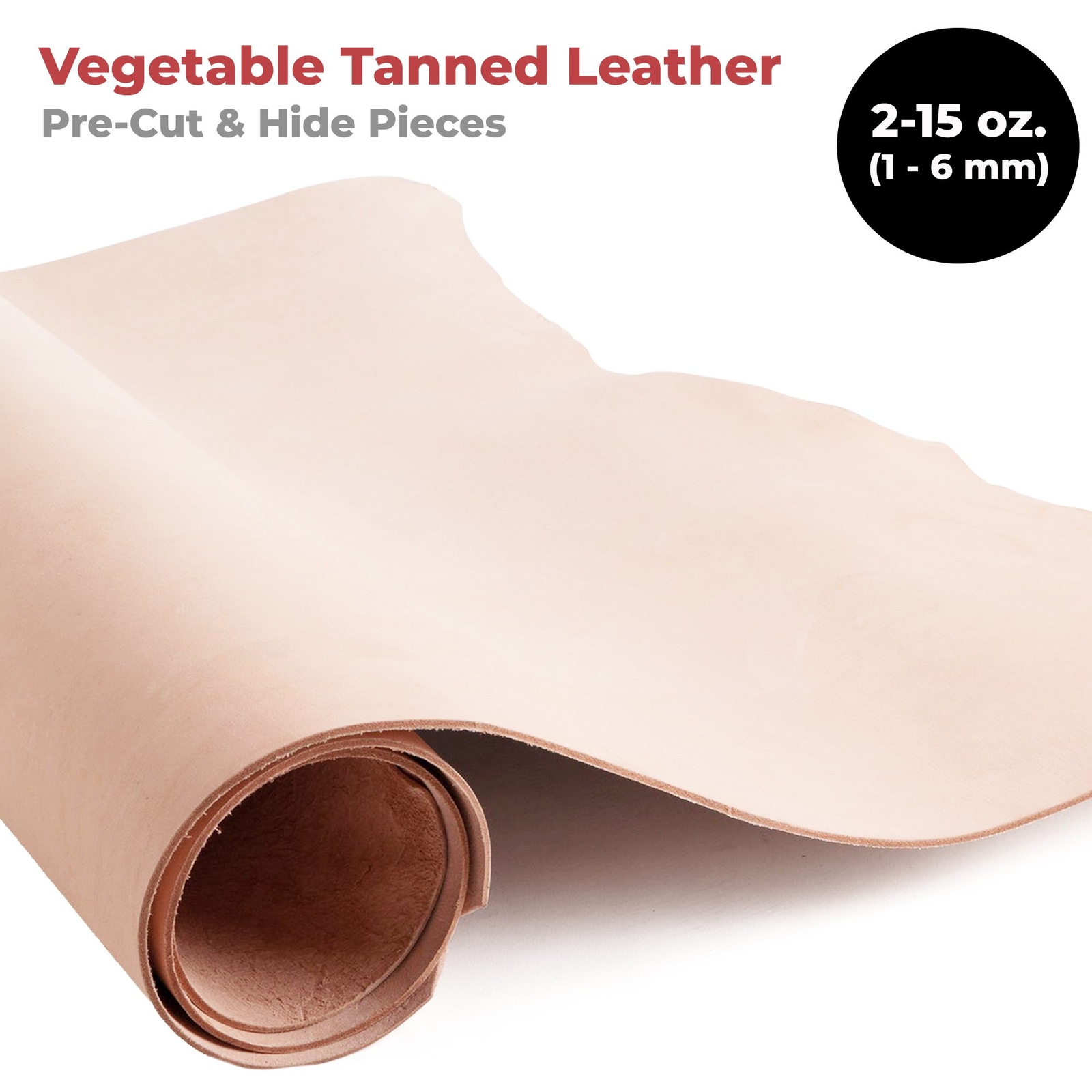

Photos from current listings. Actual item, color, and included accessories may vary.
Vegetable Tanned Hide Buying Guide
Vegetable-tanned hide is full-grain or top-grain leather cured with plant tannins, prized for firm hand, burnishable edges, and tooling response. The main trade-off is thickness and cut format: thicker sides (4-6mm) suit straps and holsters, while thinner panels (1.5-2.5mm) suit wallets and linings. Buy a side or bend from a tannery with grade disclosure for tooling work; choose pre-cut panels only when thickness is stated in both ounces and millimeters.
Key takeaways
- Tannage chemistry: vegetable tanning uses tree-bark extracts (chestnut, mimosa, quebracho) giving firm, moldable leather that darkens with age; chrome tanning is softer and not suited to carving.
- Thickness grading: 1 oz = 1/64 inch (0.4mm); common ranges are 2-3 oz (0.8-1.2mm) for linings, 4-5 oz (1.6-2.0mm) for wallets, 8-10 oz (3.2-4.0mm) for belts, 12-15 oz (4.8-6.0mm) for holsters and straps.
- Cut format matters: a full side (18-24 sq ft) gives grain consistency for large projects; a bend (shoulder-to-rump, 8-12 sq ft) is the prime cutting area; a pre-cut panel limits yield but removes grading risk.
At a glance
- Category
- Leather Hides & Panels
- Last updated
- Nov 28, 2026
Current offers
Highlights
- Tannage chemistry: vegetable tanning uses tree-bark extracts (chestnut, mimosa, quebracho) giving firm, moldable leather that darkens with age; chrome tanning is softer and not suited to carving.
- Thickness grading: 1 oz = 1/64 inch (0.4mm); common ranges are 2-3 oz (0.8-1.2mm) for linings, 4-5 oz (1.6-2.0mm) for wallets, 8-10 oz (3.2-4.0mm) for belts, 12-15 oz (4.8-6.0mm) for holsters and straps.
- Cut format matters: a full side (18-24 sq ft) gives grain consistency for large projects; a bend (shoulder-to-rump, 8-12 sq ft) is the prime cutting area; a pre-cut panel limits yield but removes grading risk.
- Firmness and temper: tannery-stuffed (waxy) veg-tan is stiffer and water-resistant; dry-milled veg-tan is softer and better for folding; both burnish with gum tragacanth or edge paint.
Best use cases
- Tooling and carving: buy a 4-5 oz (1.6-2.0mm) or 6-7 oz (2.4-2.8mm) veg-tan side or bend from a known tannery; skip chrome-tanned or soft garment leather which will not hold tooling impressions.
- Belts and straps: choose 8-10 oz (3.2-4.0mm) single-ply or 4-5 oz lined; skip 2-3 oz panels which stretch and cup under load.
- Wallets and small goods: pick 2-3 oz (0.8-1.2mm) for interiors and 4-5 oz (1.6-2.0mm) for exteriors; skip 12 oz+ hide which is too thick to skive cleanly by hand.
- Holsters and heavy cases: use 10-12 oz (4.0-4.8mm) veg-tan with firm temper; skip pre-cut panels under 8 oz which lack structural rigidity.
Buying tips
- Convert ounces to millimeters before ordering: 1 oz = 0.4mm; if a listing gives only ounces, multiply by 0.4 to confirm it matches your pattern's target thickness.
- For tooling, demand full-grain veg-tan with visible tannery stamp or grade (e.g., Hermann Oak, Wickett & Craig); unidentified 'vegetable tanned' panels often hide corrected grain or loose flank.
- Buy a bend or side rather than a panel when cutting multiple identical pieces; a 8-12 sq ft bend yields more consistent grain than a single pre-cut rectangle.
- Check temper description: 'firm' or 'stiff' suits belts and holsters; 'soft' or 'milled' suits bags and garment edges; avoid 'dry' or 'cracked' descriptors which signal poor storage.
Specs
| Tannage | Vegetable (plant tannins) vs Chrome |
|---|---|
| Thickness Range | 2-15 oz / 0.8-6.0mm |
| Cut Format | Side / Bend / Pre-cut panel |
| Grain Grade | Full-grain vs Top-grain vs Split |
Related searches
What to check before buying
- Measure your pattern's largest piece and confirm the hide or panel dimensions exceed it in both directions with 1-2 inches margin for trimming.
- Confirm thickness in both ounces and millimeters against your skiving and stitching equipment limits (hand skiving works best under 8 oz).
- Verify the tannery or grade is stated; unnamed 'vegetable tanned' leather is often corrected-grain or split and will not burnish or tool cleanly.
- Check storage and climate: veg-tan absorbs moisture; store at 50-70% RH and avoid damp basements which cause mold and dark spotting.
FAQ
Data sources: eBay / Amazon listings and product attribute feeds. Updated Nov 28, 2026.
Some links on this page are affiliate links. If you buy after clicking one, we may earn a commission at no extra cost to you. This does not change which products appear here or their order. Affiliate disclosure.