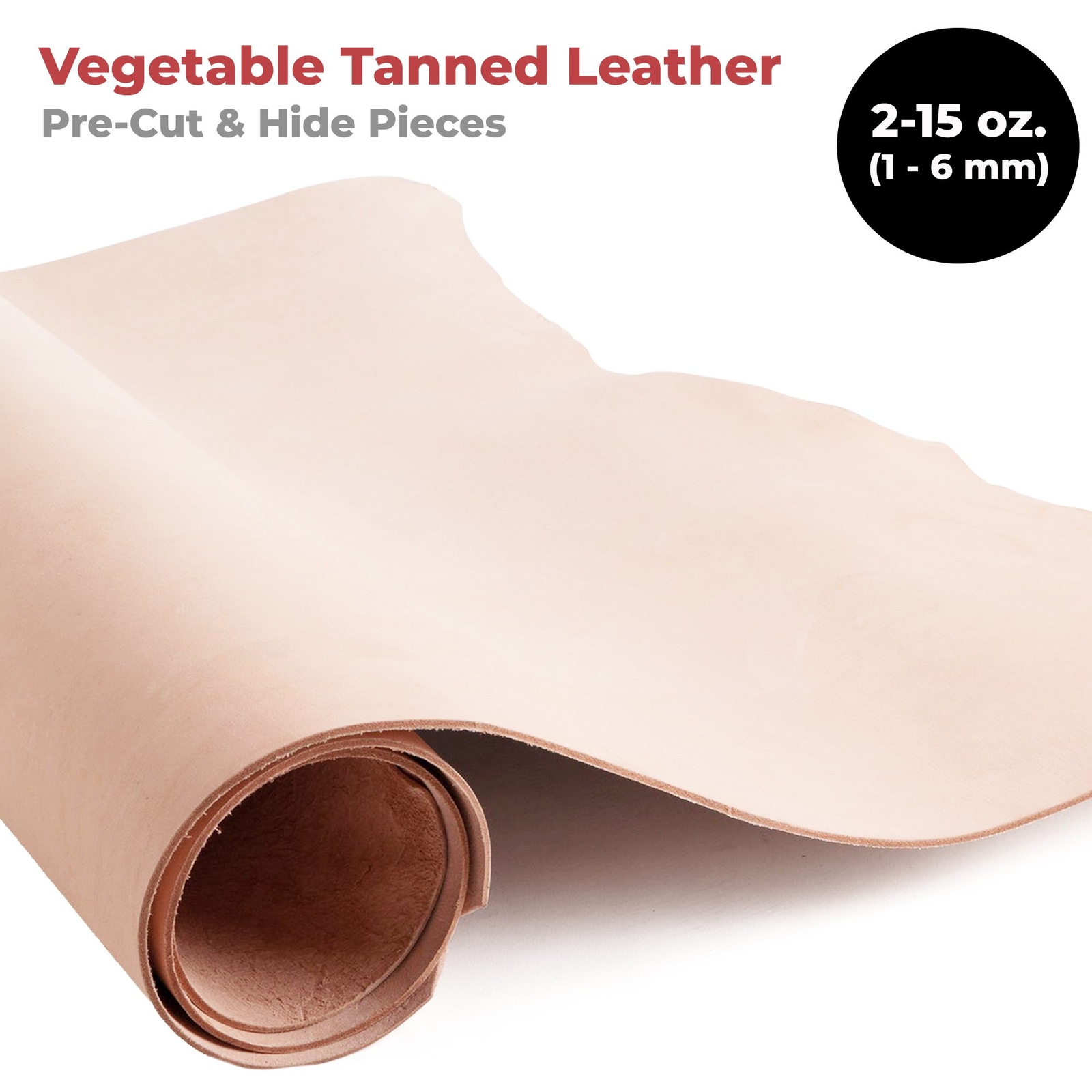

Photos from current listings. Actual item, color, and included accessories may vary.
Vegetable Tanned Leather Buying Guide
Vegetable-tanned leather is a full-grain hide tanned with plant tannins, prized for its firm hand, ability to hold tooled impressions, and a burnish that deepens with age. The primary trade-off is weight (thickness) versus workability: lighter ounces suit linings and small goods, while heavier weights are required for straps, belts, and wet-formed cases. The clear decision rule is to match ounce weight to the structural demand of the finished piece and to buy full-grain, pit-tanned or union-tanned hides over corrected-grain or chrome-tanned lookalikes.
Key takeaways
- Tannage chemistry: true vegetable tanning uses tree-bark tannins (chestnut, mimosa, quebracho) over weeks, yielding a dense, firm fiber structure that stamps and carves cleanly—unlike rapid chrome tanning.
- Weight scale: 1 oz equals 1/64 in (0.4 mm); common craft grades run 2-3 oz for linings, 4-6 oz for bags and wallets, 8-10 oz for belts and straps, and 12-15 oz for heavy tooling and soles.
- Cut grade matters: full-grain, top-grain, and split-grain describe the same hide's layers; only full-grain retains the tight outer grain that takes a burnish and patina, while corrected-grain is sanded and stamped.
At a glance
- Category
- Leather Hides & Panels
- Last updated
- Nov 28, 2026
Current offers
Highlights
- Tannage chemistry: true vegetable tanning uses tree-bark tannins (chestnut, mimosa, quebracho) over weeks, yielding a dense, firm fiber structure that stamps and carves cleanly—unlike rapid chrome tanning.
- Weight scale: 1 oz equals 1/64 in (0.4 mm); common craft grades run 2-3 oz for linings, 4-6 oz for bags and wallets, 8-10 oz for belts and straps, and 12-15 oz for heavy tooling and soles.
- Cut grade matters: full-grain, top-grain, and split-grain describe the same hide's layers; only full-grain retains the tight outer grain that takes a burnish and patina, while corrected-grain is sanded and stamped.
- Tannery format: sides, shoulders, and bellies vary in density; shoulder and bend areas are firmer for straps, while belly is looser and suited to small linings or practice pieces.
Best use cases
- Best fit: belt and strap makers should choose 8-10 oz full-grain shoulder or bend—thick enough to resist stretching under load and firm enough to edge-burnish.
- Best fit: wallet and small-goods crafters should buy 3-4 oz for outer shells and 2-3 oz for card pockets; skip anything under 2 oz for structural panels.
- Wrong fit: buyers seeking soft, drapey garment leather should skip vegetable-tanned hide entirely—its firm hand is ill-suited to apparel and will not drape without extensive breaking-in.
- Best fit: wet-forming and mold-making (holsters, masks) require 6-8 oz full-grain with tight grain; corrected-grain or split leather will not hold molded shape after drying.
Buying tips
- Convert ounce to millimeter before ordering: multiply ounces by 0.4 mm; a 6 oz hide is roughly 2.4 mm, and a 12 oz hide is roughly 4.8 mm—measure your project's seam allowance against these.
- Demand full-grain or top-grain in the listing title; 'genuine leather' and 'split' indicate lower layers with no grain, which will not tool or patina like vegetable-tanned full-grain.
- Buy by area or weight, not by 'side' alone: a side typically yields 18-22 sq ft, a shoulder 4-6 sq ft, and a belly 3-5 sq ft—confirm the square footage for your pattern yield.
- For carving and stamping, specify 'tooling' or 'carving' grade; vegetable-tanned hides marketed for tooling are case-hardened and will hold impressions, while standard vegetable-tanned may be too soft.
Specs
| Tannage | Vegetable (plant tannin) vs Chrome |
|---|---|
| Cut Grade | Full-grain vs Top-grain vs Split |
| Weight Range | 2-15 oz (0.8-6.0 mm) |
| Hide Cut | Side / Shoulder / Belly / Bend |
Related searches
What to check before buying
- Measure your largest pattern piece and add 15% waste; compare against the hide's usable square footage and confirm the cut (side, shoulder, belly) before buying.
- Check your tools: vegetable-tanned leather requires edge bevelers, burnishing gum, and stitching chisels; confirm you have these before committing to a firm, thick hide.
- Verify tannage explicitly in the listing—'vegetable-tanned' or 'pit-tanned' must appear; chrome-tanned leather will not burnish, tool, or patina the same way.
- Confirm thickness in both ounces and millimeters, and check that the seller ships flat or rolled rather than folded, which can crease firm vegetable-tanned hides.
FAQ
Data sources: eBay / Amazon listings and product attribute feeds. Updated Nov 28, 2026.
Some links on this page are affiliate links. If you buy after clicking one, we may earn a commission at no extra cost to you. This does not change which products appear here or their order. Affiliate disclosure.