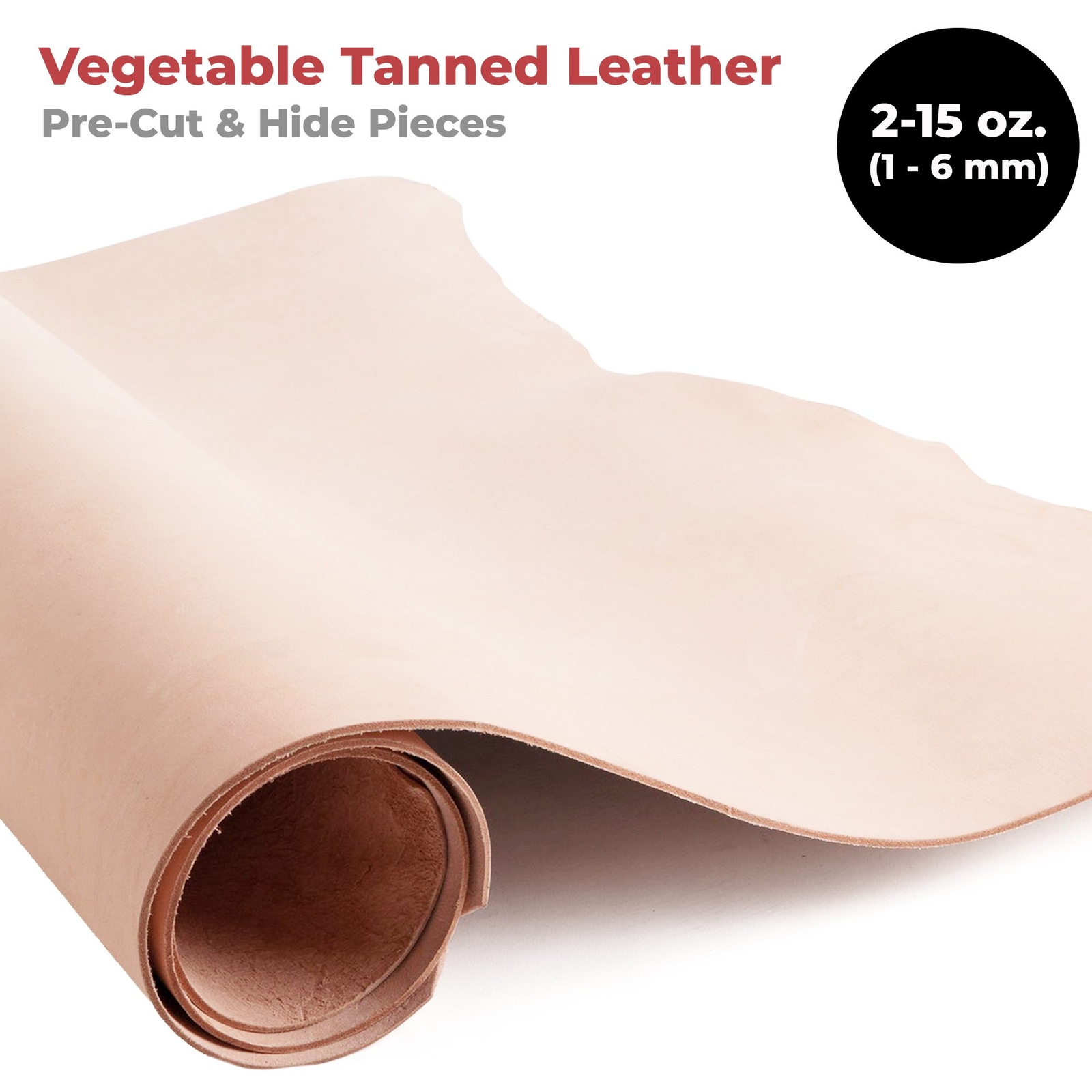

Photos from current listings. Actual item, color, and included accessories may vary.
3 Vegetable Tanned Leather Buying Guide
Vegetable-tanned leather is a full-grain hide cured with plant tannins, prized for its firm hand, clean burnish, and deep patina that develops with use. The primary trade-off is tannage purity and thickness consistency versus price: cheap sides are often belly-trimmed or over-split, which weakens the edges and stretches under load. Choose a side graded by weight range and cut location (butt/bend preferred) from a tannery with named vegetable re-tan; skip any listing that quotes only “thickness” without weight or cut.
Key takeaways
- Vegetable tannage uses plant polyphenols (mimosa, quebracho, chestnut); full vegetable leather is not chrome-free just because it looks tan—look for “100% vegetable tanned” or “veg-tanned” grade.
- Thickness is sold in ounces (1 oz ≈ 1/64 in); 3–4 oz ≈ 1.2–1.6 mm and 4–5 oz ≈ 1.6–2.0 mm—buy by ounce range, not by a single mm figure, because natural hides vary.
- Cut location sets performance: bend/butt is dense and low-stretch for straps and belts; shoulder and belly are softer, stretchier, and better for bags and molded pouches.
At a glance
- Category
- Leather Hides & Panels
- Last updated
- Nov 28, 2026
Current offers
Highlights
- Vegetable tannage uses plant polyphenols (mimosa, quebracho, chestnut); full vegetable leather is not chrome-free just because it looks tan—look for “100% vegetable tanned” or “veg-tanned” grade.
- Thickness is sold in ounces (1 oz ≈ 1/64 in); 3–4 oz ≈ 1.2–1.6 mm and 4–5 oz ≈ 1.6–2.0 mm—buy by ounce range, not by a single mm figure, because natural hides vary.
- Cut location sets performance: bend/butt is dense and low-stretch for straps and belts; shoulder and belly are softer, stretchier, and better for bags and molded pouches.
- Firmness differs by tannery and re-tan: standard veg-tan is hard and carvable; “mill-dyed” or “hot-stuffed” veg-tan is more supple and wax-rich for wallets and handles.
Best use cases
- For belts, straps, holsters, and knife sheaths: buy 4–5 oz or heavier bend/butt veg-tan—skip 2–3 oz shoulder, which stretches and cups under load.
- For wallets, card holders, and small liners: choose 2–3 oz veg-tan, or split 3–4 oz down; skip 5 oz+ panels, which bulge and resist folding cleanly.
- For molded pouches, masks, and wet-formed cases: pick 3–4 oz shoulder or bend that takes water and holds shape; skip heavily oiled or hot-stuffed sides that resist molding.
- For tooling and carving: choose 3–4 oz or 4–5 oz firm veg-tan with a tight grain; skip belly cuts and soft milled tannages that fuzz under a swivel knife.
Buying tips
- Convert ounces to millimeters before ordering: 3–4 oz ≈ 1.2–1.6 mm; 4–5 oz ≈ 1.6–2.0 mm; 6–7 oz ≈ 2.4–2.8 mm. Order a range, not an exact thickness, for natural hides.
- Demand cut location in the listing: “bend,” “butt,” or “double shoulder” are structural; “side,” “belly,” and “trim” are economy and stretch more.
- Check tannage wording: “vegetable re-tan” on a chrome-tanned crust is not full veg-tan; look for “100% vegetable tanned” or a named tannery (e.g., Hermann Oak, Wickett & Craig).
- For hardware and stitching: veg-tan accepts dye, edge paint, and burnishing well; avoid heavily waxed or oiled “pull-up” veg-tan if you need crisp dye lines and glued seams.
Specs
| Tannage Type | 100% vegetable vs veg re-tan |
|---|---|
| Thickness Range | 2–3 oz to 6–7 oz (0.8–2.8 mm) |
| Cut Location | Bend/butt vs shoulder/side/belly |
| Temper | Firm tooling vs soft milled/hot-stuffed |
Related searches
What to check before buying
- Measure your project’s largest pattern piece and add seam allowance: a side typically yields usable panels around 18–22 sq ft, but cut shape and defects reduce yield—buy 20–30% extra for layouts.
- Confirm your tools match the temper: firm veg-tan needs a head knife or strap cutter; soft milled veg-tan can be cut with rotary cutters but sags in molds.
- Check finishing supplies: veg-tan burnishes with water and gum tragacanth; chrome-tanned and heavily oiled leathers need edge paint and won’t burnish.
- Verify storage climate: veg-tan darkens and can mold above ~70% RH; store flat, dry, and away from direct sun, and condition with neatsfoot or beeswax blends, not petroleum oils.
FAQ
Data sources: eBay / Amazon listings and product attribute feeds. Updated Nov 28, 2026.
Some links on this page are affiliate links. If you buy after clicking one, we may earn a commission at no extra cost to you. This does not change which products appear here or their order. Affiliate disclosure.