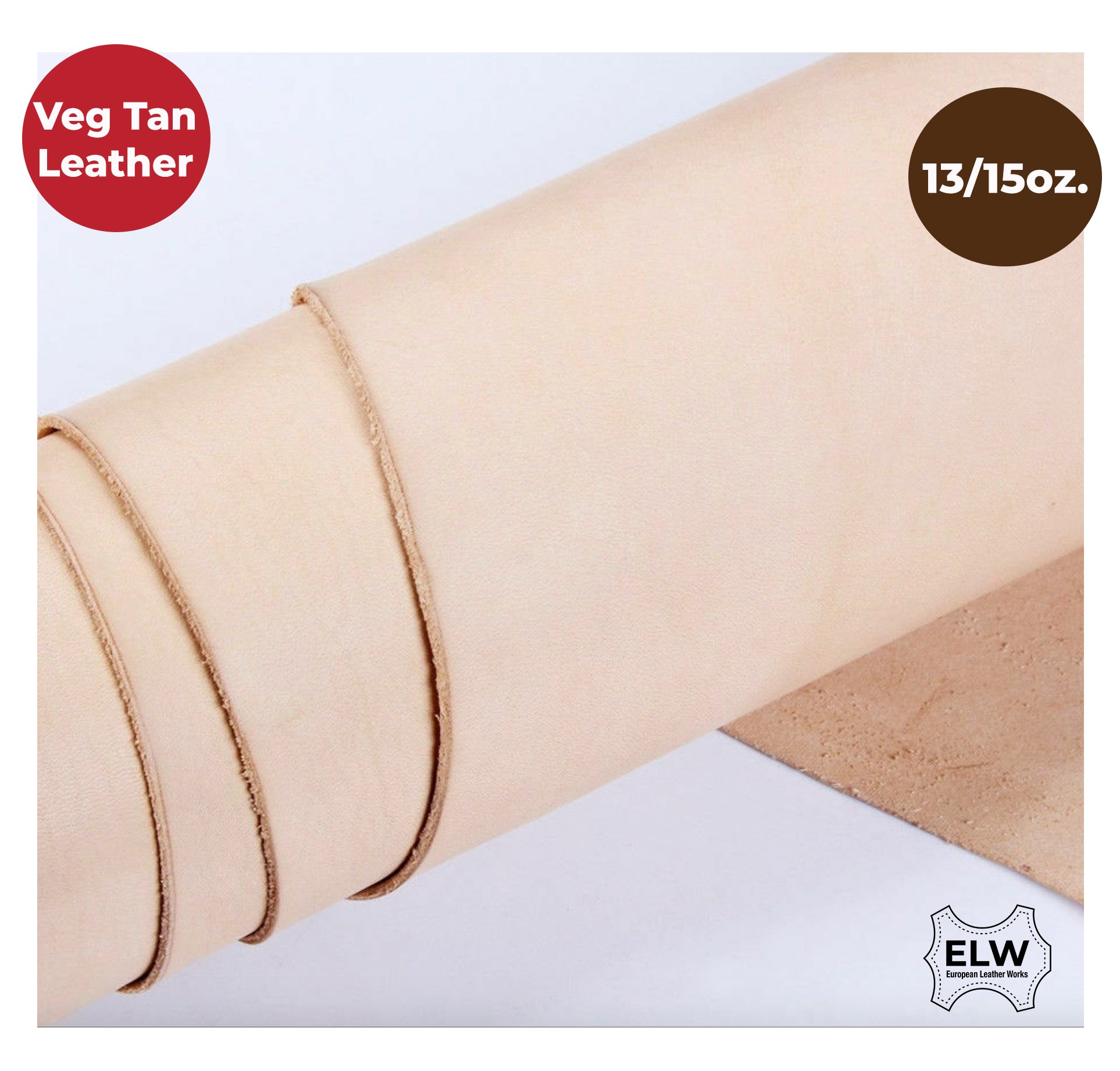

Photos from current listings. Actual item, color, and included accessories may vary.
Veg Tan Cowhide Buying Guide
Veg tan cowhide is full-grain leather cured with vegetable tannins, prized for carving, tooling, and forming because it hardens and patinas rather than cracking. The core trade-off is weight versus workability: heavier weights (12–15 oz) resist abrasion but demand serious cutting tools and are overkill for linings or small goods. The decision rule is simple—match ounce weight to the functional layer (2–4 oz linings, 4–8 oz bags, 8–12 oz straps, 12+ oz holsters and armor), and buy full-grain over split for any piece expected to outlast a decade.
Key takeaways
- Veg tan vs chrome tan: vegetable tannins (typically quebracho and mimosa) leave a firm, carveable hand that burnishes and darkens with use; chrome tan stays soft but cannot be tooled.
- Ounce-to-millimeter math: leather weight is measured in ounces per square foot; 1 oz ≈ 0.4 mm (0.016 in), so 4 oz ≈ 1.6 mm, 8 oz ≈ 3.2 mm, and 12 oz ≈ 4.8 mm.
- Full-grain keeps the intact outer grain layer for maximum fiber density and tensile strength; top-grain and split hides are sanded and weaker at the same thickness.
At a glance
- Category
- Leather Hides & Panels
- Last updated
- Nov 28, 2026
Current offers
Highlights
- Veg tan vs chrome tan: vegetable tannins (typically quebracho and mimosa) leave a firm, carveable hand that burnishes and darkens with use; chrome tan stays soft but cannot be tooled.
- Ounce-to-millimeter math: leather weight is measured in ounces per square foot; 1 oz ≈ 0.4 mm (0.016 in), so 4 oz ≈ 1.6 mm, 8 oz ≈ 3.2 mm, and 12 oz ≈ 4.8 mm.
- Full-grain keeps the intact outer grain layer for maximum fiber density and tensile strength; top-grain and split hides are sanded and weaker at the same thickness.
- Bridle and harness grades are dense veg tan pieces selected for strap and tack work; they resist stretching under load far better than generic craft sides.
Best use cases
- Best fit: leather tooling, carving, and stamping—choose 6–10 oz (2.4–4 mm) full-grain veg tan panels that hold impressions without sponging.
- Best fit: knife sheaths, gun holsters, and armor—pick 10–14 oz (4–5.6 mm) bridle-grade hides that wet-form and harden into rigid shapes.
- Best fit: belts and straps—select 8–12 oz (3.2–4.8 mm) single-ply or 4–6 oz lined twice; skip thin 3 oz panels that stretch under belt tension.
- Wrong fit: upholstery, garments, or linings—veg tan is too firm and stiff; use chrome-tanned or garment-weight leather instead.
Buying tips
- Compute thickness before ordering: divide the ounce weight by 2.5 to approximate millimeters; 8 oz is about 3.2 mm, not 4 mm, and a 1 mm error changes tool and thread choices.
- Choose full-grain over top-grain or split whenever the piece will be carved or load-bearing; only the intact grain layer develops the dense patina and resistance veg tan is bought for.
- For any strap or belt over 1 inch wide, require 8 oz (3.2 mm) minimum; thinner veg tan elongates permanently under sustained tension.
- Inspect cut edges: clean, square, undelaminated edges signal a properly split hide; fuzzy or split edges mean the piece was cut from a lower-grade or split layer.
Specs
| Tannage | Vegetable (quebracho/mimosa) |
|---|---|
| Grain Grade | Full-grain vs top-grain/split |
| Weight Range | 3–15 oz (1.2–6 mm) |
| Panel Size | 8x8 in to 24x48 in (sides) |
Related searches
What to check before buying
- Measure your project's largest flat pattern piece; a 24x48 in panel yields roughly 8 square feet, so confirm the hide or panel covers your layout with 10–15% waste.
- Confirm your cutting setup handles the weight: 12–15 oz (4.8–6 mm) leather needs a head knife or heavy rotary cutter, not a standard craft blade.
- Check your tooling surface: 1/8 in (3 mm) cutting mats protect tables and blades; punching holes or shapes requires a polymer or HDPE mat, not self-healing vinyl.
- Verify finishing supplies match veg tan: gum tragacanth, beeswax, and water-based dyes bond to vegetable-tanned surfaces, while solvent dyes formulated for chrome tan can blotch.
FAQ
Data sources: eBay / Amazon listings and product attribute feeds. Updated Nov 28, 2026.
Some links on this page are affiliate links. If you buy after clicking one, we may earn a commission at no extra cost to you. This does not change which products appear here or their order. Affiliate disclosure.