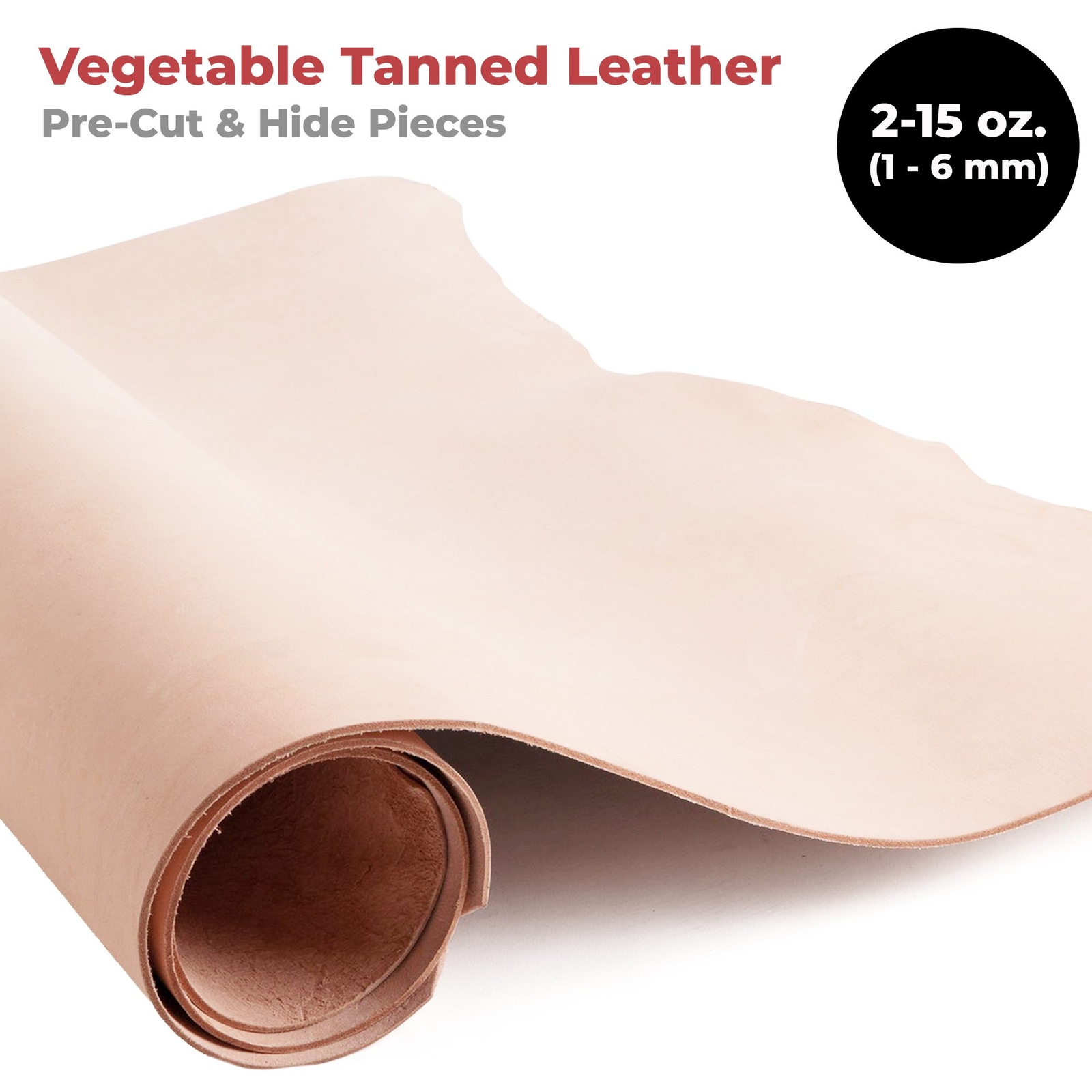

Photos from current listings. Actual item, color, and included accessories may vary.
Vegetable Tanned Cowhide Buying Guide
Vegetable-tanned cowhide is a full-grain or top-grain leather cured with plant tannins, prized for its firm hand, carve-ability, and patina development. The primary trade-off is thickness consistency and cut format: sides and shoulders offer large usable area but variable density, while pre-cut panels guarantee uniform thickness at the cost of size flexibility. Buy sides or shoulders for large projects and pre-cuts only when you need guaranteed uniform thickness in small pieces.
Key takeaways
- Vegetable tanning uses plant tannins (often mimosa or quebracho) producing firm, moldable leather that darkens with UV and handling, unlike chrome-tanned leather which stays soft and color-stable.
- Thickness is graded in ounces: 2–3 oz (0.8–1.2 mm) for linings and wallets, 4–5 oz (1.6–2.0 mm) for bags, 6–8 oz (2.4–3.2 mm) for belts and holsters, 10–15 oz (4–6 mm) for heavy straps and soles.
- Full-grain vegetable-tanned hides retain the outermost grain layer for maximum tensile strength and patina; top-grain is sanded for uniformity but loses some surface durability.
At a glance
- Category
- Leather Hides & Panels
- Last updated
- Nov 28, 2026
Current offers
Highlights
- Vegetable tanning uses plant tannins (often mimosa or quebracho) producing firm, moldable leather that darkens with UV and handling, unlike chrome-tanned leather which stays soft and color-stable.
- Thickness is graded in ounces: 2–3 oz (0.8–1.2 mm) for linings and wallets, 4–5 oz (1.6–2.0 mm) for bags, 6–8 oz (2.4–3.2 mm) for belts and holsters, 10–15 oz (4–6 mm) for heavy straps and soles.
- Full-grain vegetable-tanned hides retain the outermost grain layer for maximum tensile strength and patina; top-grain is sanded for uniformity but loses some surface durability.
- Pre-cut panels are sliced from larger sides, so they offer consistent thickness but limited dimensions; sides and shoulders provide 12–24 sq ft of usable area with natural density variation across the hide.
Best use cases
- Choose a full side or shoulder (4–6 oz) for tooling, carving, and large bag panels where you need continuous grain and can work around natural density shifts.
- Choose pre-cut panels (2–3 oz for linings, 6–8 oz for straps) when your pattern fits within the cut size and you need guaranteed uniform thickness without skiving.
- Skip heavy 10–15 oz hides for small accessories like wallets—they are too stiff and thick; reserve them for belts, dog collars, and load-bearing straps.
- Skip thin 2–3 oz sides for structural bags or belts—they lack the tensile strength and will stretch; use them only for linings, pockets, and small goods.
Buying tips
- Match ounce rating to project: 2–3 oz for linings and wallet interiors, 4–5 oz for bag bodies and knife sheaths, 6–8 oz for belts and holsters, 10–15 oz for heavy straps and soles.
- For sides and shoulders, expect 10–20% thickness variation across the hide; if your pattern requires uniform thickness, buy pre-cut panels or plan to skive.
- Vegetable-tanned leather is firm and molds with water; if you need drape or softness, choose a milled or tumbled vegetable-tanned variant rather than standard firm sides.
- Check cut dimensions against your largest pattern piece: pre-cut panels typically range from 6×12 in to 12×24 in, so verify your pattern fits before buying.
Specs
| Tannage | Vegetable (plant tannins) vs Chrome |
|---|---|
| Thickness Range | 2–15 oz (0.8–6 mm) |
| Cut Format | Side / Shoulder / Pre-cut panel |
| Grain Grade | Full-grain vs Top-grain |
Related searches
What to check before buying
- Measure your largest pattern piece and confirm it fits within the pre-cut panel dimensions or that a side/shoulder offers enough continuous area.
- Confirm the ounce rating matches your project's structural needs: under 3 oz for linings, 4–8 oz for bags and belts, 10+ oz for heavy straps.
- Verify you have a stitching pony, diamond awl, and heavy-duty needles (size 0 or 00) for thick vegetable-tanned leather; standard sewing machines may not handle 6+ oz.
- Plan for edge finishing: vegetable-tanned edges burnish with water and gum tragacanth, so budget for edge bevelers and burnishing tools.
FAQ
Data sources: eBay / Amazon listings and product attribute feeds. Updated Nov 28, 2026.
Some links on this page are affiliate links. If you buy after clicking one, we may earn a commission at no extra cost to you. This does not change which products appear here or their order. Affiliate disclosure.